


U.S. lawmakers have challenged FIFA over “opaque” ticket pricing for the World Cup, accusing it of misleading practices and artificial scarcity to manipulate demand.
DALLAS — Ticket prices for the World Cup have drawn ire from soccer fans around the world and U.S. lawmakers alike, who recently wrote a letter to FIFA demanding an explanation for their “opaque” use of dynamic pricing.
U.S. representatives Frank Pallone and Nellie Pou, both New Jersey Democrats, sent a letter to FIFA President Gianni Infantino on Thursday asking for details by May 22 on FIFA’s “dynamic pricing;” the number of unsold tickets currently available in what FIFA calls its “Last-Minute Sales Phase;” when additional tickets will be released; whether new categories will be added; and the justification for fees on its Resale/Exchange Marketplace.
“For many fans hoping to attend matches this summer, the ticket sales process has become a major point of frustration,” they wrote. “We are deeply concerned by reports that FIFA is employing opaque pricing, shifting rules and potentially deceptive practices.”
The lawmakers also accused FIFA of misleading seat maps.
“FIFA also appears to be restricting ticket supply to shape demand,” they added. “Tickets are reportedly being held back for matches, creating the appearance of limited availability even when large numbers remain unsold. This pressures fans to purchase quickly while allowing FIFA to control pricing through staggered releases.”
FIFA’s media office did not immediately respond to an Associated Press email seeking comment on the letter.
The artificial ticket scarcity that the lawmakers are referring to — and its effect on the resale market — is easily illustrated when you look at the pricing over time. In the graph below, you can see the pricing for all nine matches to “Dallas Stadium” from October 2025 until this writing.
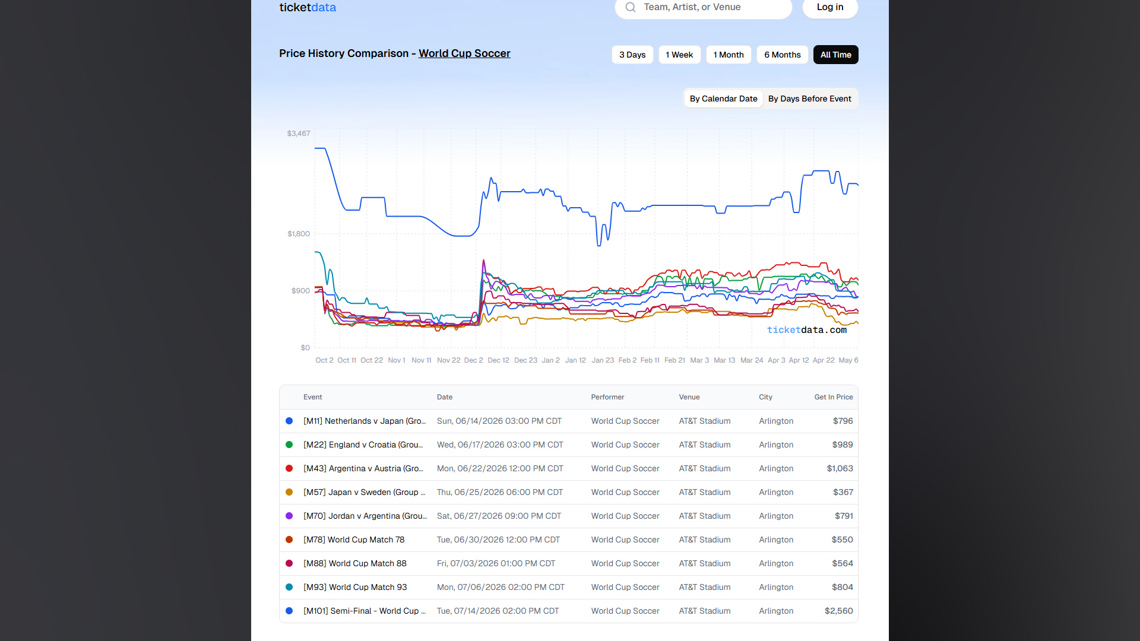
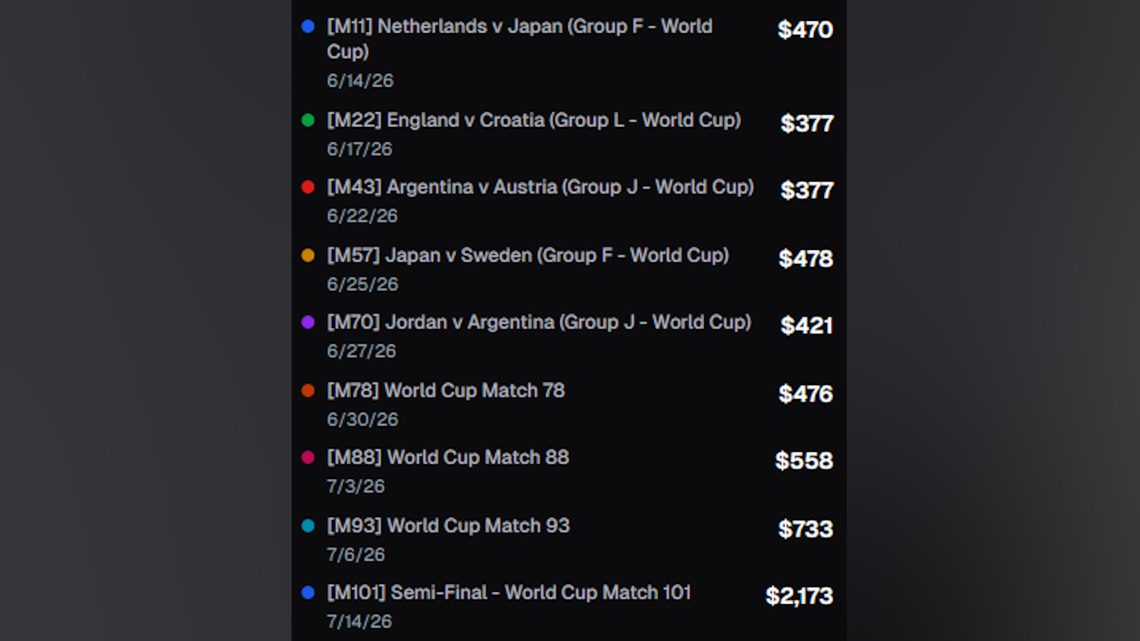
When you look at the prices more granularly at different checkpoints along the way, you see how controlled ticket demand has shaped the secondary market.
Dallas Stadium World Cup price snapshot – October 2025 (via Ticket Data)
When people bought these tickets, they had no clue which teams were playing. The field of teams hadn’t even been determined yet. Then, on Dec. 5, the group draw happened. So, we finally knew which teams were playing where. And Dallas Stadium got one heck of a draw. The secondary market prices on Dec. 7 showed a huge spike for high-profile matches.
Dallas Stadium World Cup price snapshot – Dec. 7 (via Ticket Data)
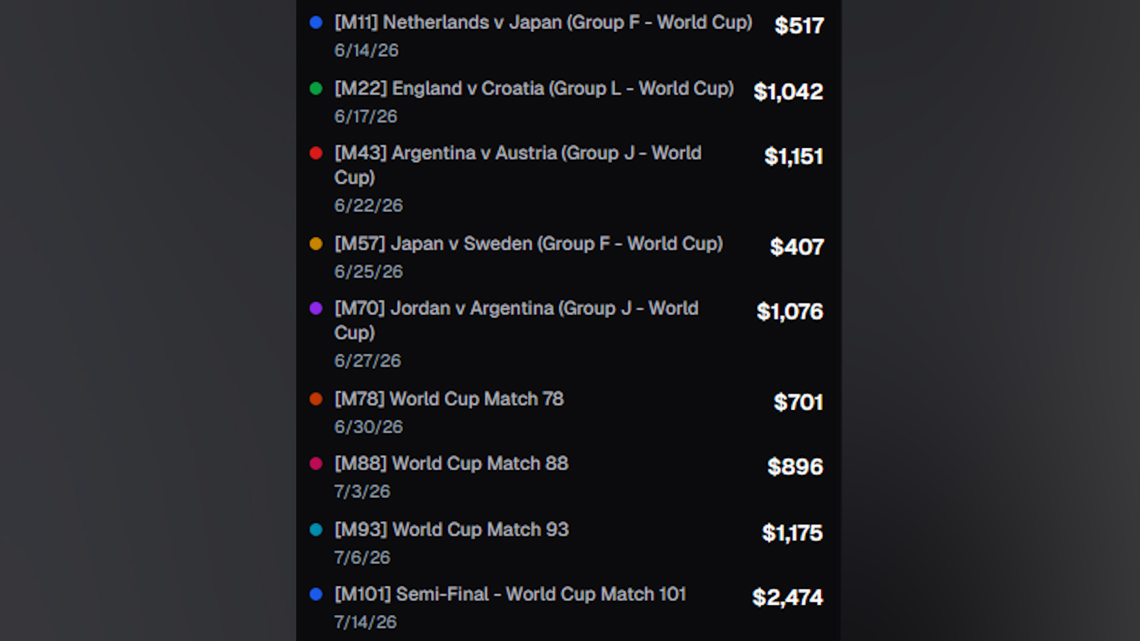
Matches like England vs. Croatia, one of the only top 10 matchups in the tournament, shot to over $1,000. Matches featuring defending champion Argentina, with Lionel Messi on the marquee, also rose to more than $1,000 each.
All of these get-in prices were for the secondary market during FIFA’s lottery ticket stages, which is largely where people had to get them from. WFAA reported that less than 1% of applicants for the lottery ticket stages were able to buy tickets directly from the FIFA platform.
FIFA holds tickets back during Last Minute Sales phase and does ‘ticket drops’
Then, FIFA opened up its Last Minute Sales Phase, which transitioned from a lottery concept to first-come, first-served at the beginning of April. But the catch here was, they did not release all the tickets at once. FIFA President Gianni Infantino has admitted the soccer governing body has withheld tickets throughout the process in order to sell them throughout the end of the tournament.
Infantino has defended the scrutiny against World Cup ticket prices, citing the overwhelming demand. He’s previously used metrics like the amount of ticket application requests (500 million), as well as saying the U.S. market rate for sports justifies the higher prices.
“We have to look at the market. We are in a market in which entertainment is the most developed in the world, so we have to apply market rates,” he said Tuesday at the Milken Institute Global Conference in Beverly Hills, California. “In the U.S. it is permitted to resell tickets, as well, so if you were to sell tickets at the price which is too low, these tickets will be resold at a much higher price. And as a matter of fact, even though some people are saying that the ticket prices we have are high, they still end up on the resale market at an even higher price, more than double of our price.”
Infantino added, “You cannot go to watch in the U.S. a college game, not even speaking about a top professional game of a certain level, for less than $300.”
Since the Last Minute Sales Phase opened on April 1, there have been three “ticket drops” — April 1, April 22 and May 7.
In between these dates, match selection was extremely limited.
In fact, WFAA checked multiple times and Dallas Stadium matches were not available at all from April 1 through the second ticket drop on April 22. From April 22 until May 7, a handful — never more than five — of Dallas Stadium matches became available, but most of them labeled as “limited availability.”
This concept of artificial ticket scarcity has continued to bolster FIFA’s argument of “supply and demand.” Look at how the resale market prices were affected.
Dallas Stadium World Cup price snapshot – April 22 (via Ticket Data)
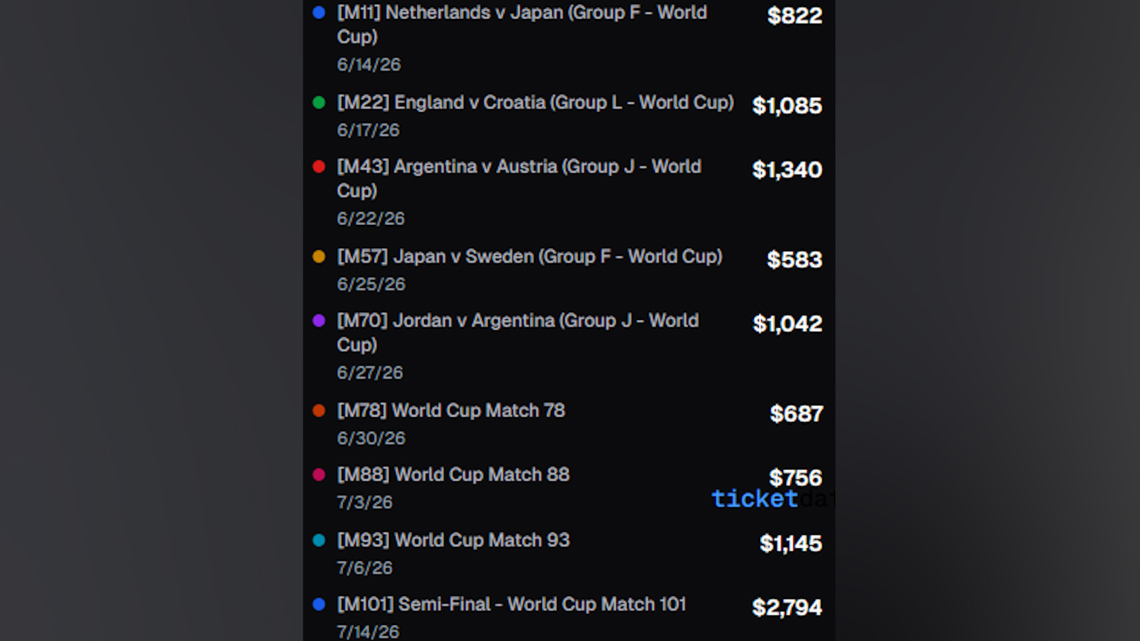
Prices, generally, continued to rise from April 1 to April 22 due the illusion that there weren’t any tickets left to be sold. Prior to the ticket drop on April 22, FIFA said in a press release that 5 million tickets had been sold. WFAA has previously reported that approximately 7 million tickets are available for all 104 matches. That’s roughly 72 percent.
How many tickets have been sold since April 22 is unclear.
A FIFA press release from April 21 stated the cumulative attendance record of 3.5 million set at the 1994 FIFA World Cup — which was also hosted in the U.S. — is “on course” to be broken.
The FIFA World Cup kicks off on June 11, where host nation Mexico takes on South Africa. The first match in DFW will be the Netherlands vs. Japan on June 14. AT&T Stadium will host nine World Cup matches in total, including the first semi-final match of the tournament.
