



Bennett School’s Karson Reeder, right, celebrates after a home run during a high school sports academy baseball game in Houston, Wednesday, March 25, 2026.
Jason Fochtman/Houston ChronicleWhen junior Karson Reeder stepped off the mound in the fifth inning of the UIL Class 6A Division II state championship game last June, he had thrown his last pitch for Tomball High School.
Instead of returning to Tomball for his senior season and perhaps a third trip to state, Reeder enrolled at The Bennett School, a baseball-centered institution powered by the Texas Sports Academy and the Austin-based AI-propelled Alpha School.
Reeder, who has signed to play with the University of Texas, said the decision to leave Tomball was not made lightly.
Article continues below this ad
“I can get all the development I need with the best coaches,” he said. “I’ve been there, done that, and I don’t have to over-pitch, throw another 100 innings. I think it’s a good opportunity and play against the best and not just dominate the teams that are not as good. Get in there, play the best competition, really prepare yourself.”
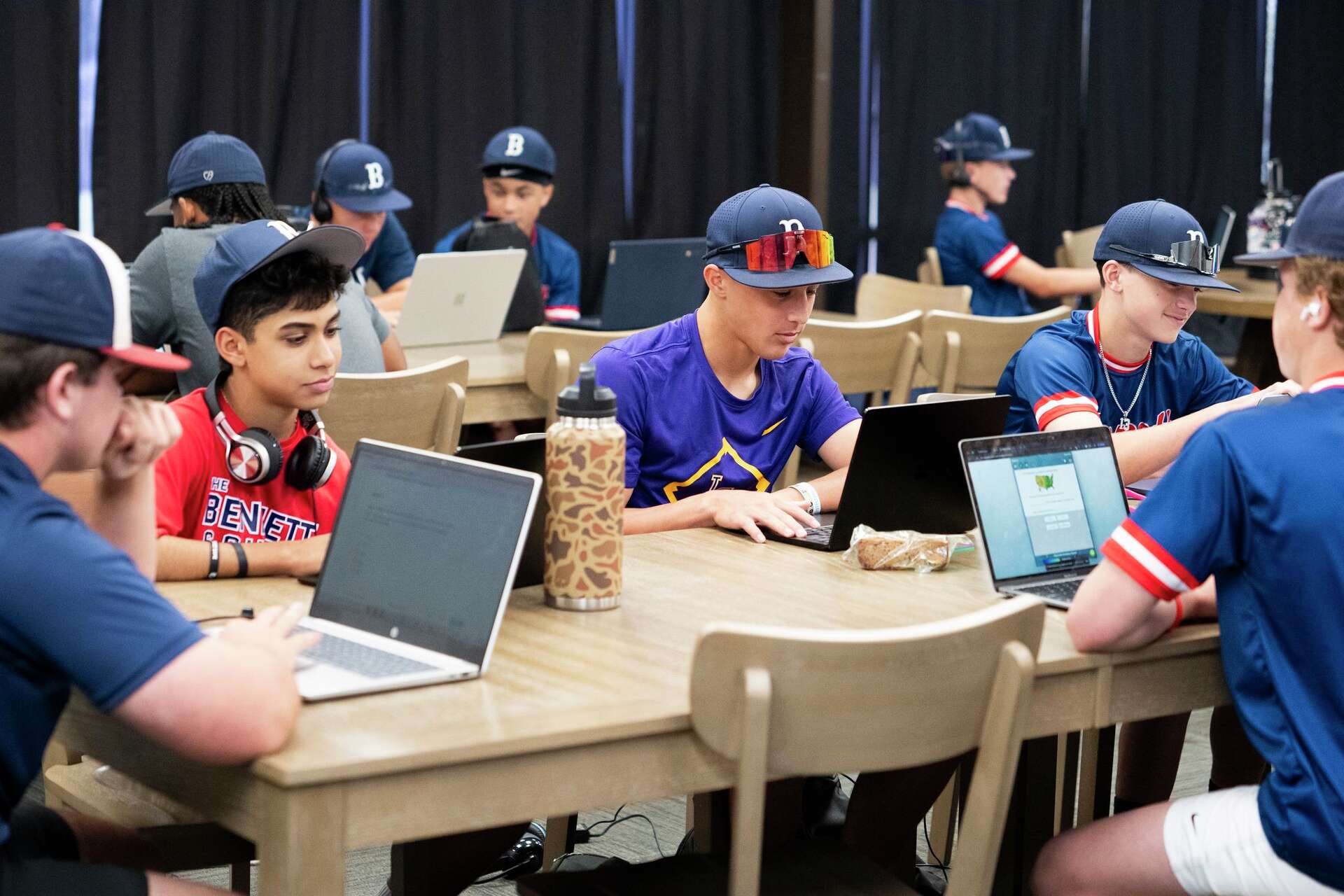
The Bennett School is the first high school and middle school sports academy of its kind in the Houston area. Utilizing the Alpha School curriculum — a two-hours-per-day learning model powered by artificial intelligence — students are able to complete the academic portion of their day in the morning and spend the afternoon focusing on baseball development.
Texas Sports Academy is essentially the athletics division of the Alpha School. With several locations across Texas — including Dallas, Austin and San Antonio — the organization has schools focused on multiple activities, from basketball to gymnastics to martial arts. The Bennett School has gained notoriety since its opening for its untraditional academic structure, but also because several of the top high school baseball players in the Houston area have chosen to join the program.
Article continues below this ad
“When I really decided that I wanted to make a future out of baseball, I understood this was the best opportunity for me to do that,” said J.T. Darden, a former Cypress Woods High School outfielder who has signed with Oklahoma State and is spending his senior year at Bennett. “Obviously, school is important, and we make sure that’s important here as well. We get our work done personally, at our own pace, and then at the end of the day, we can do all the baseball development that we need with all the coaches that know what they’re doing. It gives me an opportunity to really focus on that area of development with something I plan to make a future out of.”

Bennett School’s Carter Jockers, right, and Watson Dowell work on school work during a high school sports academy baseball game in Houston, Wednesday, March 25, 2026.
Jason Fochtman/Houston ChronicleAI in the classroom
Alpha School and Texas Sports Academy officials say the AI-based programs they use can help accelerate and boost learning in a variety of ways. According to Lamar Cannon, the head of partnerships for Texas Sports Academy, one of the biggest benefits the academic structure offers is giving what was previously classroom time back to the students and their and families. It’s one of the most distinct departures from traditional schooling, which requires more hours during the day.
“We believe that model is kind of outdated,” said Cannon, the brother of former Texans and Patriots offensive lineman Marcus Cannon. “A lot of students, if you talk to them, you realize that they’re wasting six hours a day in school. We’re kind of giving the kids their time back. Students are able to learn two to six times faster with this academic structure than with traditional school because there’s individualized tutoring that happens with the AI app. It meets the students where they’re at.”
Article continues below this ad
The Alpha School website makes several claims about its effectiveness, including that its students experience 2.6-times-faster growth than peers on nationally normed Measures of Academic Progress (MAP) tests and that a majority of them consistently outperform national averages. It also says the top performers achieve up to 6.5-times faster growth.
RELATED: Virtual school enrollment has skyrocketed in Texas, up 1,200% in 10 years. Is it a new normal?
When vouching for the Alpha School efficacy, Cannon referenced the “2 Sigma Problem” study, conducted by Benjamin Bloom, an American educational psychologist, in 1984. The primary takeaway from that study was that students who receive one-on-one tutoring perform 98% better than traditionally taught peers. It also asserts that mastery of a topic before moving forward is critical, and that veering from that concept can create learning gaps. The “problem” part of the study is that tutoring can be too expensive and resource-intensive to provide to everyone. The Alpha School claims to have solved that using AI.
“From this Bloom study, the conclusion was that this is the best way to teach kids, but it’s not scalable,” Cannon said. “We can’t have a classroom with 25 teachers, and we can’t have one teacher for every student in the United States. So the study was kind of ignored. But now, with AI, it’s possible to have individualized learning and for students to get that same tutoring.”
AI in the classroom isn’t a new concept. But advancements in the field in recent years have changed the way it can be utilized in learning. Jaclyn Ocumpaugh, an associate professor of curriculum and instruction at the University of Houston whose research deals directly with AI in education, said there are a large range of models in the space and that they are not all created equal with the same depth of research and fine-tuning.
Article continues below this ad
“Efforts have been around to use various forms of AI since the ’90s,” Ocumpaugh said. “It’s just that nobody recognized anything as looking like artificial intelligence until the large language models emerged a few years ago. … Since then, we’ve seen major, major leaps with how realistically human these appear to be, and that’s really shifted things.”
The Alpha School has a proprietary AI engine called “Incept,” which analyzes two aspects for each student. The first is their knowledge base — what they already know. The other is their interests — what excites and engages them. That two-pronged approach, the school’s website says, allows its system to generate lessons that are effective on an educational level and also personally compelling, which delivers better results.

The MLB network plays as Bennett School students work on laptops during a high school sports academy baseball game in Houston, Wednesday, March 25, 2026.
Jason Fochtman/Houston ChronicleThe Bennett School co-founder Brandi Dowell said her children were not getting what they needed in Houston ISD classrooms and that the traditional education system was failing them. She and her husband eventually reached a breaking point, which prompted them to pursue change. A commodities trader by profession, Dowell partnered with fellow co-founder Gregg Bennett and formulated a plan.
Bennett is the namesake of the school, the former director of the Center for Sport Management Research and Education at Texas A&M and the founder of Twelve Baseball, a select organization based in College Station. He focused on putting the baseball program together, while Dowell focused on adding the educational component through the Texas Sports Academy. She also takes care of all the business and day-to-day operations.
Article continues below this ad
“The leap of faith was probably smaller for me than for the rest of these families, because I personally was to a point where I felt like we had nothing to lose,” said Dowell, who spent years lobbying her school district officials to make some changes. “It couldn’t have gotten any worse, and I had enough confidence in the academic piece with Alpha that the kids were going to be fine academically. They were going to graduate. They were going to be super competitive on the academic side.”
Though its model has not yet been subject to independent studies available to the public, the Alpha School uses MAP testing results to back its claims of academic progress. Dowell said students at her academy saw significant growth — with her estimated average around 11- or 12-times the national norm — between testing done in August and testing done at the beginning of this year.
“That’s what I’m most proud about, and these kids are super proud about it,” said Dowell, who has four sons, three of whom are enrolled at The Bennett School. Her oldest is now at the University of Texas, and her high school senior, Judson, is signed to play baseball at Rice University. “They came in and took those MAP tests and saw they were (for example) in the 25th percentile, and now they’re in the 75th percentile, and they realize they’re very capable and very intelligent.”

The MLB network plays as Bennett School students work on laptops during a high school sports academy baseball game in Houston, Wednesday, March 25, 2026.
Jason Fochtman/Houston ChronicleThe Bennett School conducts its educational sessions and athletic training at the Baseball USA complex off Beltway 8 just north of the Memorial area. Students navigate their AI lessons on laptops with a “guide” on site to help with any potential issues that arise. Once daily studies are completed, the focus shifts to baseball. The school website says The Bennett School offers assistance with college recruitment, advanced analytics and video analysis, a strength and conditioning program and mental game and leadership development — things that go hand-in-hand with its baseball training and competition.
The staff at The Bennett School includes Russel Reeder, Karson’s father, who focuses on player development and serves as an academic guide. He has 26 years of teaching experience and played independent professional baseball for five years. He previously served as the head coach at Magnolia West High School (2009-12) and as an assistant at several other programs.
“The model here is about being able to compress everything to a time frame that’s doable,” Russel Reeder said. “With the structure we have here, you can take care of all of the things you need to get done, and at 3 o’clock, I’m home, and I can be a teenage kid, and I can see my family and have dinner with them at the table. When you ask them, ‘Did you get everything you needed knocked out today?’ Yeah, they did. Sign me up. That’s awesome. It’s just a blessing to be able to do it.”
Bennett has two sons who both played four years of high school baseball and said it was a “terrific” experience for his family. He said the criticism of his academy is rooted in misunderstanding and that The Bennett School has a completely different objective than the traditional path players take with high school baseball. The primary focus for The Bennett School is development and getting players ready to compete at the next level, whether that’s in college or in the professional ranks.
“Texas high school baseball coaches are trying to win,” Bennett said. “That’s the primary concern, and they’re trying to win a state championship, which is great. The community is trying to support that. You’re playing with your neighborhood friends, all that stuff. Those things are great. There’s nothing wrong with them. I think they’re fantastic. But we’re not doing that. That’s what I’m saying. It’s a very different path, it’s a different model, and it’s a different business altogether.”

Bennett School players celebrate after Clayton Crosby’s home run during a high school sports academy baseball game in Houston, Wednesday, March 25, 2026.
Jason Fochtman/Houston ChronicleVouchers and impact on public schools
Tuition at The Bennett School is currently $15,000, which is significantly cheaper than the most expensive private school options in Houston, according to data compiled by the Chronicle. The school is also eligible for the statewide voucher program that was passed through legislation as Senate Bill 2 last spring. Formally known as the Texas Education Freedom Accounts (TEFA), they provide families with taxpayer funds to offset the cost of private or homeschool education. Launching with the 2026-27 school year, eligible children can receive more than $10,000 per year toward tuition at accredited private schools.
The Bennett School meets the required criteria for the voucher program, which has been pushed by Gov. Greg Abbott for several years. Those opposed to the program have raised concerns that it takes funding away from the public school system. Funding for Texas public schools is based on attendance, and even small reductions can lead to significant cutbacks. Districts across the state have to budget for a lot of fixed costs, including teacher and support staff pay, facilities operations and more.
The rise of sports academies in Texas has been met with opposition from the Texas High School Coaches Association, which issued a letter to its members in February titled “Educate. Excel. Play: A Call to Action to Protect Education-Based Athletics in the State of Texas.” It includes a checklist for high school coaches and administrators to follow in regard to the sports academies, which the organization’s leaders believe are a threat to the fabric of community-driven high school athletics. The decree from the THSCA includes not scheduling games with teams from the academies and not allowing them to rent public school facilities. It also emphasizes educating parents and promoting and reinforcing the value of public school athletics.
THSCA executive director Joe Martin said that because of the decisions made by legislators regarding the voucher program, public school administrators and coaches feel like they need to recruit their own kids simply to pay the bills.

J.T. Durden’s arm band is seen with a Bible verse during a high school sports academy baseball game in Houston, Wednesday, March 25, 2026.
Jason Fochtman/Houston Chronicle




“We feel like those academies are taking kids out of public schools, and it impacts budgets,” Martin said. “So we got together with the other associations in the state of Texas and came up with a plan to promote public schools, not to attack academies. We don’t want to change their narrative. We just want to educate everybody on ours. We want to educate everybody on all the great things public schools are doing and what our coaches are doing for our high school athletes in this state.”
Joshua Childs, a former college athlete who’s now an associate professor of educational leadership and policy at the University of Texas, said academies like The Bennett School are challenging the way school has traditionally been viewed and have created a new way to package academics with sports for young athletes aspiring to compete at the next levels.
“I think, especially since the pandemic, since 2020, the options of what schooling can look like have obviously expanded,” said Childs, who’s also a member of the communication and collaboration advisory committee for the Texas High School Coaches Association and helps the organization design curriculum for its coaches. “Parents have recognized that they have more choices and there’s more options available for how their students can learn and will learn. So I think what we’re seeing now is a shift in what education can and will look like in the future. I think the Alpha School is just one of those examples of what the market, especially in Texas, has allowed, which is the creation and expansion of a schooling model like that.”
According to Childs, the “million dollar question” is about the middle ground between traditional education and innovative options like the Alpha School. Can the gap be bridged, or are the two concepts too foreign? What kind of long-term impact will these issues have on high school athletics and the students, coaches, administrators and parents involved in them?
“I think there are more questions to be asked, but I would also say that parents and families and communities are wanting options and choices, and that I think this should be a sort of a wake-up call for those of us who care about our traditional education, our traditional public schools,” Childs said. “It’s an opportunity to really do some internal reflection about what works and what doesn’t work. And one thing that does work really well, especially in the state of Texas, is our athletics — the ways in which our public schools engage in athletics and education-based athletics. So I think there’s an avenue and a path to think about how our traditional schools can stay relevant and continue to do well and prosper.”

Bennett School’s Karson Reeder is seen on deck during a high school sports academy baseball game in Houston, Wednesday, March 25, 2026.
Jason Fochtman/Houston ChronicleImpact on UIL baseball
Texas high school baseball is a longstanding institution. The University Interscholastic League has been handing out state championships in the sport since 1949. The opening of The Bennett School in Houston has certainly impacted programs that have lost players, but it hasn’t yet risen to the level of a serious threat to public high school baseball as a whole. Dowell said academies like The Bennett School might not be the right fit for everyone, but the goal is to offer athletes a choice in how they pursue their goals.
Bennett said that because of the ever-changing landscape in college athletics, preparation is more important now than ever.
“I think it starts with the notion of player development and what that really means,” Bennett said. “There’s a lot going on if you look at the space that’s next for these young men. It’s college baseball or pro baseball, right? It’s tough to go into a major college at this point if you’re not prepared. The transfer portal and NIL and the way things are working make it very difficult to walk into a University of Texas and play. We’ve known that for a couple years now, so we’re trying to prepare them for that.”
The Bennett School has a premier team — one composed of several Division I-bound athletes, including Reeder and Darden — that is playing a national schedule this spring. It’s included trips to Louisiana, Alabama, Florida and Tennessee and boasted some talented opponents currently ranked in the MaxPreps national top 25 like Barbe (Lake Charles, La.), Farragut (Knoxville, Tenn.), IMG Academy (Bradenton, Fla.) and South Walton (Santa Rosa Beach, Fla.). While The Bennett School’s main focus is development, rather than winning games, the Rebels have a 24-4 record and are ranked No. 8 in the country. They are the second-highest nationally ranked Texas team, coming in behind only No. 3 Tomball, which has a 25-0-1 record.
Tomball coach Doug Rush started coaching in 1986 and has seen how high school athletics have evolved. He believes baseball and other sports might follow in the footsteps of soccer, where Texas coaches have been battling to keep their top players from ditching the high school season in favor of playing exclusively for their club teams. Rush said that high school baseball and select baseball have co-existed for years, giving kids the opportunity to compete in both. But he believes that with the advent of academies like The Bennett School, that dynamic has begun to change.
“They just can’t really call themselves a high school,” Rush said. “It’s not high school sports. It’s just select sports, showcase sports that have been extended into the high school seasons because people found a way, or found a loophole, to make money, and that’s what they do. So they sell it as something where, if you don’t play with the elite, you’re not going to get a look (from colleges). It’s fine if they go do that. I just don’t believe schools like that belong in high school rankings. I don’t even believe they should be playing other high schools because they recruit, and they openly recruit. It is what it is. It’s fine if we have those, and I give my blessing to any kid who wants to go do it, but it’s not high school. It’s a loophole around high school.”

Bennett’s J.T. Durden jogs toward the dugout from the outfield during a high school sports academy baseball game in Houston, Wednesday, March 25, 2026.
Jason Fochtman/Houston ChronicleRush lost two of his top players to The Bennett School when Reeder and fellow senior Harper Gates, both now captains for the Rebels’ premiere team, decided to pursue the new opportunity. But their departure hasn’t slowed down the Cougars, who will be looking to make a third consecutive state championship game appearance in Texas’ largest classification come June.
“Our mantra is tradition never graduates, and the kids have just gotten used to the way we do things, the way we go about trying to win games,” Rush said. “I think it’s kind of a combination of incredible fun and a lot of discipline and accountability, and we’re kind of in a mode now where it just feeds itself. We’ve gone to the third round of the playoffs in all but one of the past 15 years. So this year, yeah, we lost a couple of good guys to the Bennett academy, and they’re both awesome kids. I love them both, but it also gave some other guys, the younger guys, a chance to step up, and they’re doing a great job of doing that.”
Rush, who has 660 career wins and two state championships on his résumé, said the value of competing in Texas high school baseball is something that’s not replicable elsewhere. While not all programs will get a chance to reach the pinnacle of the sport like his Tomball teams did in 2013 and 2024, he said the lessons learned during the pursuit are what matter the most.
“I know there’s some high schools that don’t have the talent level we do, but the competition in our program breeds development,” Rush said. “We’ve got a bunch of kids who are really good on their select teams in the summer, and then they have to learn how to come together in the spring and become teammates and learn how to fight for a position and learn how to play for something bigger than themselves, and they work their tails off to do it. Our kids benefit greatly from that.”

