

On Saturdays, crowds gather at the stadium, and the following week, a concert is held at the same university. Weekdays are filled with meetings and banquets, and on weekends, wedding guests visit. There are restaurants next door, and those who have traveled from afar stay in hotels.
In the context of US college sports, movements to create this kind of year-round flow of people are becoming increasingly prominent. There is the University of Kentucky’s entertainment district initiative, the University of Tennessee’s stadium-adjacent development, and the University of Texas’s large-scale arena. And then there is Boise State University, which I previously covered in this note regarding athletic department financial issues, and its creation of an organization that manages sports and entertainment in an integrated manner.
When these cases are lined up, it becomes clear that the management of college sports is expanding from revenue generation centered on games to businesses that utilize facilities and their surroundings throughout the year. It cannot be said that universities across the country are moving in unison. However, it is a change that multiple universities are concretizing in ways tailored to their respective markets and assets.
Facilities cannot be managed on game days alone
Stadiums and arenas have a great ability to attract crowds on game days. However, looking at the year as a whole, there are more days when no competitions are held. The attempts by the universities covered here are aimed at filling those gaps with concerts, meetings, dining, and lodging, and creating value for the facilities and their surroundings on a daily basis.
Kentucky: Creating ‘everyday life’ next to the stadium
The University of Kentucky is planning a district around its football home, Kroger Field, that combines restaurants, hotels, conference and event facilities, and retail. The university’s official explanation cites both enhancing the fan experience and year-round use by university affiliates and the local community as the objectives of the same project. It is also a plan to unlock the commercial potential of sports facilities and support the financial foundation of athletic operations.
Fans arrive early to eat and spend time in the area after the game. If there are facilities to accommodate that time, the day spent visiting the university becomes longer. Furthermore, if people who come for meals or meetings on non-game days are added, the use of the district will no longer be dependent solely on the competition schedule. How these demands are layered is the key to understanding this plan.
Tennessee: Sports and live entertainment in one district
The University of Tennessee presents this vision of year-round use as a more concrete space. On September 16, 2026, the university announced the name of the district being developed adjacent to Neyland Stadium as ‘865 Neyland.’ The plan combines approximately 100,000 square feet (about 9,300 square meters) of indoor and outdoor dining, commercial, and entertainment space with a 24-story hotel and residential tower. The entertainment district is scheduled for completion in 2028.
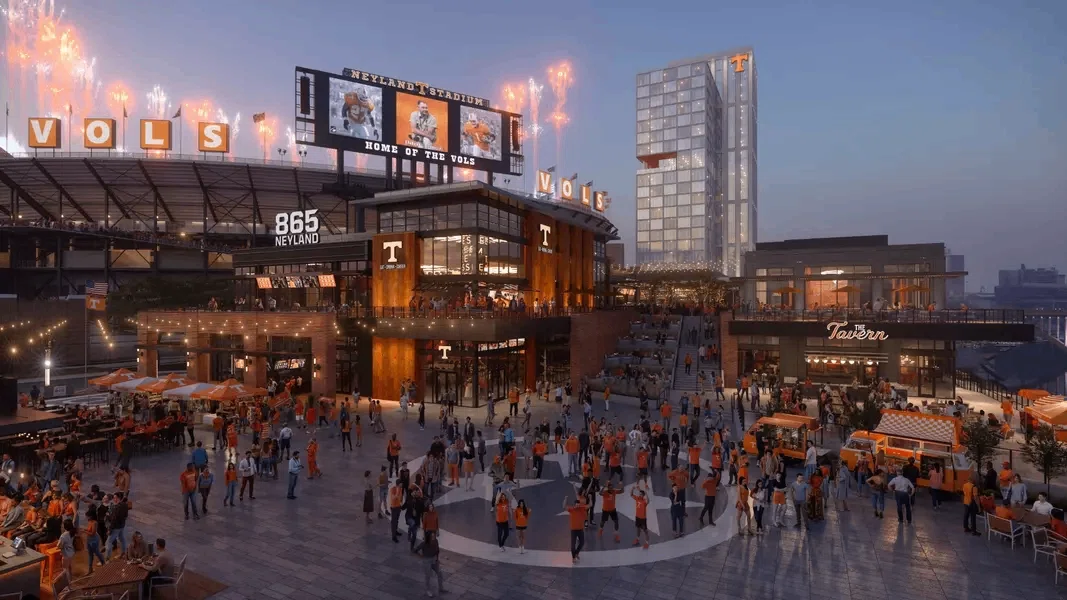
It includes two outdoor plazas, one of which will feature a performance stage equipped with a large LED screen. It is intended for use for artist performances, game viewing events, and special occasions. The project is being advanced as a public-private partnership between the university, RVX Ventures, Magellan Development Group, and Arctos Sports.
Here, the significance of creating a place where events can be held outside the stadium is great.
Even without using a stadium that holds tens of thousands of people every time, events can be organized that fit the scale of the plazas and restaurants. The necessary crowd-attracting devices differ between big game days and ordinary weekends. It can be read as an idea to provide a place within the district that can absorb those differences.
Boise: Created an operating organization before the buildings
In this regard, I would like to recall Boise State University. In May 2026, the university established the ‘Boise State Sports & Entertainment Group’ within its athletic department. It is a department that handles event attraction, production, promotion, ticket sales, merchandise sales, and facility management across venues such as Albertsons Stadium and ExtraMile Arena. The university has indicated a policy of becoming a destination that fans visit throughout the year.
What I want to highlight in this case is that the responsibility for operations has been consolidated. Even if a venue is empty, it does not necessarily mean that people who want to use it will appear naturally. Work to realize an event is required, from sales to organizers, estimates, scheduling, setup, promotion, and day-of operations. If multiple venues can be handled together, it is also possible to propose locations according to the scale and budget of the project.
When considering the management of an athletic department, the number of attendees on game days and broadcasting rights revenue are easy-to-understand indicators. On the other hand, who tracks the days when facilities are empty, where to market them, and what to implement are things that are difficult to see from the outside.
Texas: Putting the power of music entertainment into university facilities
There is also a way to incorporate the power of specialized companies. The Moody Center at the University of Texas at Austin is an arena with over 15,000 seats that hosts the university’s men’s and women’s basketball games and large-scale concerts, and it officially promotes more than 150 nights of entertainment per year. In addition to the university, Oak View Group, Live Nation/C3 Presents, and others are partners.
The facility’s slogan is ‘Built for Music. Designed for Austin.’ It balances a design conscious of music performances with the hosting of college sports in a single venue.
This combination shows that the ability to attract performances is just as important as the building itself. A venue is evaluated based on its relationships with tour promoters and artists, its capacity for stage production, and even its ticket sales and customer service. How to connect the expertise of live entertainment to the location and brand that a university possesses—that is also a design requirement for the commercialization of university facilities.
Kansas: The Gateway District, which even captures conference demand
The University of Kansas’s Gateway District further incorporates conference demand. The first phase, completed in August 2025, connected football facilities, the stadium, and a new conference facility on the north side. The university has outlined a vision for subsequent phases that includes hotels, retail, and student housing.
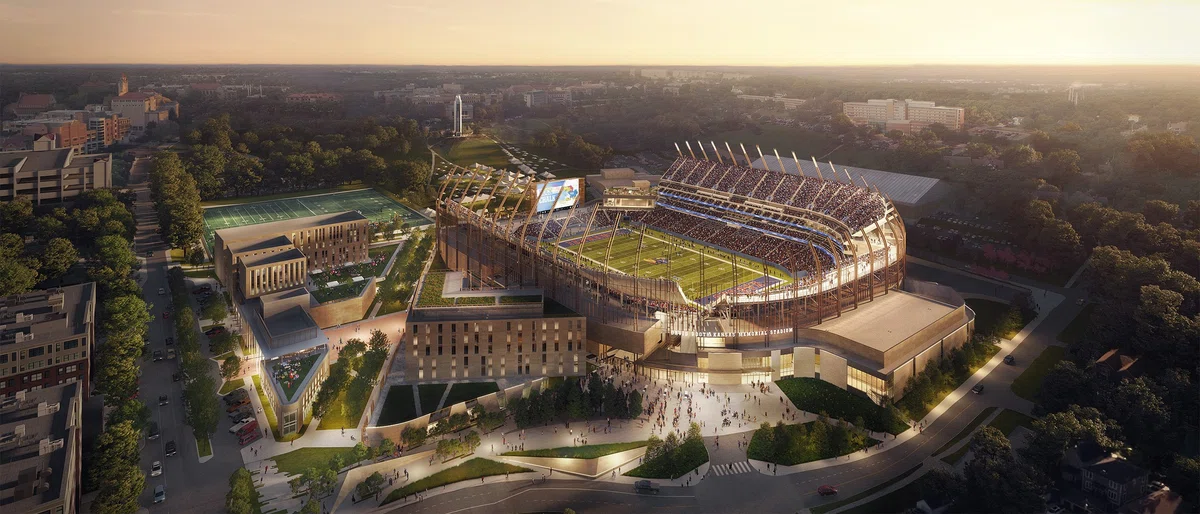
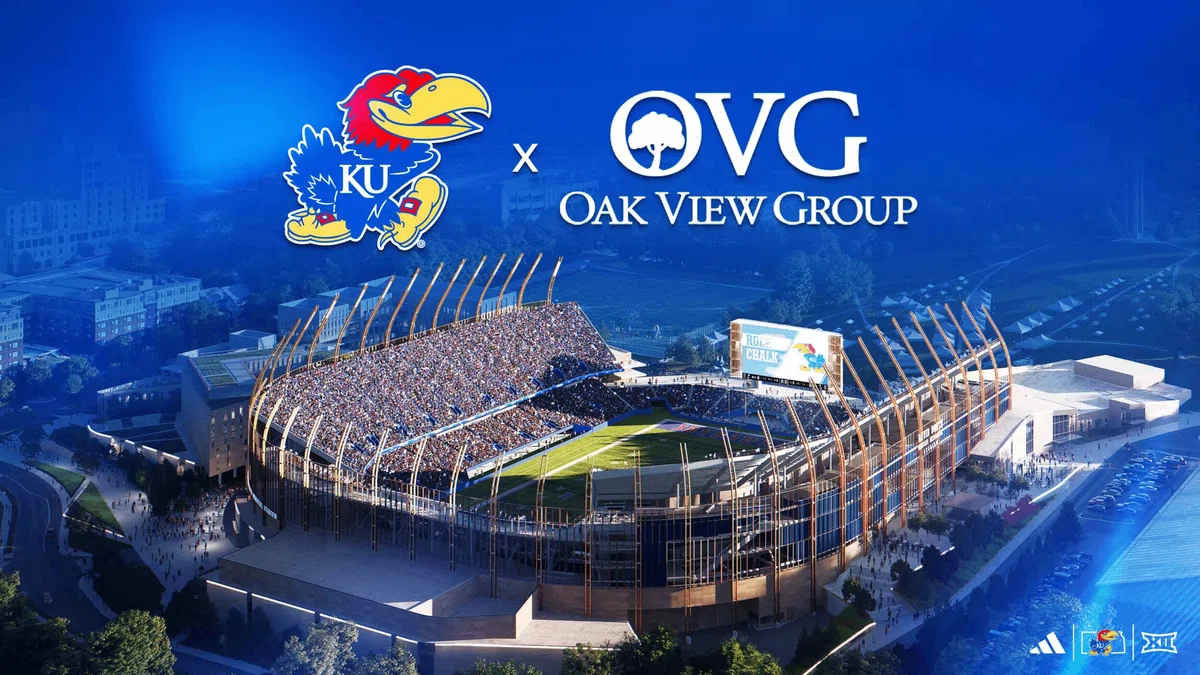
In 2024, the university announced a partnership with Oak View Group, indicating a policy where the company would handle the daily operations of the stadium and conference facility, as well as the attraction of conferences and concerts. It is a system that also coordinates with the university’s own conference and event department.
Conferences are not as high-profile as music performances. However, universities have touchpoints with diverse visitors, including researchers, businesses, and alumni. If the conferences and networking spaces where these people gather are linked to athletic facilities, it creates opportunities for them to visit the campus for reasons other than watching sports. Such daily usage is essential when considering the annual operation of a district.
The ‘Non-Game Day Management’ common to five universities
Looking across these five universities, the focus of their efforts differs slightly. Kentucky and Tennessee are characterized by peripheral development, Boise by the integration of operating organizations, Texas by collaboration with music entertainment, and Kansas by mixed-use development including conference facilities. What they have in common is that they are assembling university land and facilities into a business that attracts people from the region.
From here on, we will look at the management perspective for evaluating each plan.
How to evaluate glamorous conceptual designs
First, it is necessary to distinguish between the consumption generated in the region and the revenue that remains with the university. Hotel sales, restaurant revenue, and concert ticket sales do not automatically become athletic department income. What the university receives is rent based on contracts, facility usage fees, and a share of operating profits. Only after deducting maintenance, personnel costs, repairs, and debt repayment from that can the effect on the university’s finances be judged.
Similarly, even if a venue is filled by a large performance, the stability of the business cannot be measured by that day alone. Setup and teardown take time, and the field also requires protection and restoration. How many days can be secured before the next game or practice? Will revenue-generating events put pressure on athletic preparations? Increasing annual utilization is a job that includes this kind of coordination.
District development further demands daily demand. Even restaurants that are crowded on game days may not necessarily have sufficient usage on weekdays. At what times and for what purposes do students, faculty, staff, local residents, and corporate conference guests visit? To turn a glamorous conceptual design into an actual business, it is necessary to verify those detailed demands.
There are also evaluation criteria unique to universities. Will the time and space available for students be secured? How will new revenue be funneled back into improving the environment for athletics and education? Can it handle surrounding traffic and noise? Will it become a space where local people can easily drop by? To grow a business while maintaining the value of the university as a place, these conditions must be concretized at the operation and contract stages.
In that sense, viewing this movement simply as ‘entertainment facilities are increasing at universities’ captures only half of the change. Behind the buildings, the work of those who sell, those who plan, and those who operate is being reorganized. What to build and how to use it throughout the year have become a single management challenge.
If starting in Japan, first start with an inventory of existing facilities
When considering this in Japan, there is no need to start by building hotels and arenas on the same scale as in the U.S. First, organize which university facilities are empty and when, what kind of usage demand exists in the region, and who will accept and operate those requests. It is possible to explore room for giving existing spaces new roles while protecting on-campus usage.
What Boise demonstrated was the importance of the organization responsible for that operation. Kentucky and Tennessee are trying to expand that way of thinking to the area surrounding the stadium. In Texas and Kansas, they are combining university assets with the attraction and operational capabilities of specialized companies.
The stadium becomes a part of the city’s daily life
The days when cheers echo through the stadium are when a university’s appeal is most clearly visible. However, how familiar that place becomes to the city is also reflected in how it is used on days without games. Eating, listening to music, attending meetings, or celebrating family milestones. As these visits accumulate, the points of contact between the university and the community increase.
The next management challenge for college sports is to link that daily usage to revenue that can continue to support education and athletics. The creation of entertainment hubs currently underway at U.S. universities is an attempt to build that mechanism from both a structural and organizational perspective.
As of writing: September 20, 2026. Completed facilities, ongoing developments, and future concepts are described separately. The sections regarding revenue structures and evaluation metrics are the author’s analysis based on information published by each university and do not estimate unpublished contracts or profits of individual projects.
