

The Boston Globe
An experimental device that uses light and sound to stimulate the brain appeared to slow cognitive decline in people at early stages of Alzheimer’s disease, according to mixed results from a clinical trial announced Nov. 16 at a scientific conference in Boston.
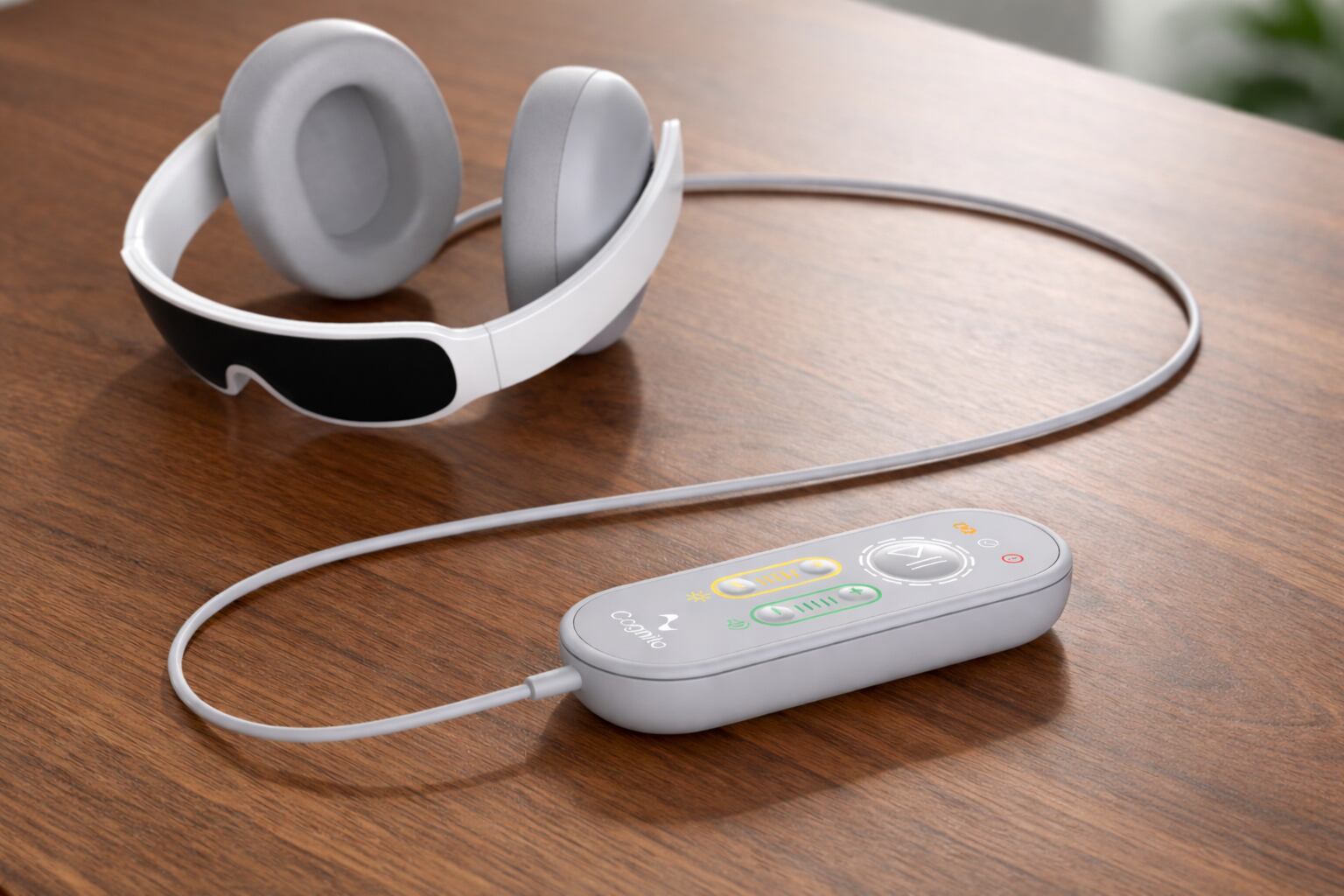
Cognito Therapeutics, the Cambridge-based biotech company behind the device — which can be used at homeand looks like a pair of sunglasses attached to headphones — said the findings could hold promise for millions of people with the incurable illness.
The results, which have not yet been peer-reviewed, will be submitted to the New England Journal of Medicine, the company said.
“The potential implications are massive,” said Christian Howell, Cognito’s CEO. “Many people have the ability to bring this into their lives and really positively impact what they’re experiencing.”
But the trial, the largest of this device to date, was designed to measure efficacy in people with mild to moderate Alzheimer’s and did not show a treatment effect in the overall group ofpeople who used the technology. The data did suggest that people with mild Alzheimer’s who used Cognito’s device could experience slower cognitive decline, especially if they used it almost every day for nearly an hour, as recommended.
“There’s a hint that there may be something there, but it’s unproven and needs to be verified,” said Heather Snyder, senior vice president of medical and scientific relations at the Alzheimer’s Association.
The invention, which is called Spectris, uses gamma wave therapy and is based on research by MIT scientists.
Gamma waves are electrical signals that brain cells make when people are learning or concentrating. Although neuroscientists have known that these signals are slower or missing in people with Alzheimer’s, it wasn’t until 2016 when researchers led by MIT neuroscientists Li-Huei Tsai and Ed Boyden first discovered that the brainwaves had the potential to be a therapy.
The MIT researchers learned they could trigger gamma waves in mice using simple light and sound stimulation. They observed that the brainwaves could clear mouse brains of sticky clumps of proteins called amyloid plaques, known to accumulate in the brains of Alzheimer’s patients. Tsai and Boyden went on to cofound Cognito and remain as scientific advisors to the company.
The technology, Howell noted, does not clear amyloid plaques or tau, another brain protein associated with Alzheimer’s, in people. But researchers found that when people’s brains are stimulated at 40 hertz, it can help preserve brain structure and function, Howell said.
“It’s not that the amyloid plaques or the tau tangles are actually driving the loss of cognition and function,” Howell said. “What they’re causing is network dysfunction. The neurons are no longer able to fire in synchrony. The brain is no longer able to maintain healthy activity levels.”
Snyder likened what happens in the brains of people with Alzheimer’s to a basketball team that’s not in sync.
“If they’re in sync and they’re synchronized, you have these beautiful plays,” she said. “If that group is out of sync, then they don’t get the ball down the court, they don’t score the basket.”
“The idea behind this device is: Can you get that team back in sync?” she continued.
Research has also shown that stimulating the brain at that frequency can reduce neural inflammation and help repair the function of nerve cells, Tsai said.
“In general, it has a very broad neuroprotective effect,” she said.
Results from the trial, which included more than 600 participants who were followed for a year, showed that the new device appeared to work in people with mild cognitive impairment but not for those with moderate cases.About half of the study’s participants were randomly assigned to use the device, while the others received a placebo, known as a sham device. Participants were instructed to use the device for at least 50 minutes a day, at least five days a week.
In people with early symptomatic Alzheimer’s, the device slowed decline by 56 percent based on one common measure of functioning. Against another measurement, it slowed decline by 47 percent.
“It’s incredible,” said Tsai, who was not directly involved in the trial. “With the mild population of Alzheimer’s disease, the treatment showed such a large effect.”
Dr. Stephanie Buss, a cognitive neurologist at Beth Israel Deaconess Medical Center and the center director of the Memory A2Z Clinic in the Cognitive Neurology Unit, said the device is “really exciting” to consider. But, she said, the results leave some unanswered questions.
“I’d like to learn more about the subgroup that did respond,” said Buss, who was not involved in the trial. “It’s plausible it works for some, but not for all.”
She added that if the device were approved by the Food and Drug Administration, it could be “a great addition” to current Alzheimer’s treatment, but not a replacement.
Two approved Alzheimer’s drugs on the market, Leqembi and Kisunla, work by targeting amyloid plaques andhave been shown to have modest effects on slowing cognitive decline. They have side effects, including temporary brain swelling.
Cognito Therapeutics plans to petition the FDA for approval next year and could receive authorization by the end of 2027, Howell said.
Globe correspondent Madyline Swearing contributed to this report. Material from previous Globe stories was used in this report.
Clarification: An earlier version of this story misstated the group of Alzheimer’s patients whose decline slowed by at least 47 percent after using the Spectris device. That group was those with early symptomatic Alzheimer’s.
