
*Previous articles related to this topic are introduced at the end of this piece.
01 What Happened: High School Soccer Final Attendance Hits a Tournament Record of 60,142
What you’ll learn in this chapter: How many spectators gathered for the High School Soccer Championship final, and when this year’s tournament begins.
This article was written for companies considering sponsoring high school sports. By comparing sponsors of the High School Soccer Championship with those of American high school sports, we provide insights to help you consider whether a national tournament or a local competition best aligns with your company.
The final of the All Japan High School Soccer Tournament takes place in January after the New Year. According to reports by Soccer King, 60,142 spectators gathered at the Japan National Stadium for the 104th final held on January 12, 2026. This surpassed the previous final’s 58,347 attendees, setting a new tournament record for attendance.
Two days before the final, the Japan Football Association announced that there would be no same-day ticket sales because the planned allocation had completely sold out. This means that tickets for a high school tournament final had sold out in advance.
And this year, the 105th tournament is set to begin. By November 15, all 48 qualifying schools nationwide were decided. According to tournament information from the Japan Football Association, it will kick off on December 28, with the final taking place at the Japan National Stadium on January 11, 2027.
Sixty thousand people gathering for a high school tournament, broadcast nationwide on television. While this sight may seem commonplace in Japan, it is extraordinarily rare when compared to American high school sports. That is because in the United States, the national federation of state high school associations does not sanction high school national championships where school teams compete for the national title.
The information in this article is current as of November 2026.
02 The Background: High School Soccer Championship Sponsors and the Structure of Broadcaster-Organized Tournaments
What you’ll learn in this chapter: Who organizes the High School Soccer Championship and which companies support it as sponsors.
Organized by the Japan Football Association and 43 Commercial Broadcasters
According to tournament information from the Japan Football Association, the organizers of the 105th High School Soccer Championship are the Japan Football Association and 43 commercial television broadcasters. The All Japan High School Athletic Federation co-hosts, supported by the Japan Sports Agency, the Yomiuri Shimbun, and boards of education across the Tokyo metropolitan area.
A total of 48 teams participate: one team each from 46 prefectures, and two teams from Tokyo, which has the highest number of schools. Matches are held across 10 venues in Tokyo, Kanagawa, Saitama, and Chiba, with the opening ceremony, semifinals, and final taking place at the Japan National Stadium.
List of Sponsors for the High School Soccer Championship (105th Tournament)
The sponsors and partners listed in the same tournament information are as follows:
-
Sponsors: Meiji, Fujifilm Business Innovation, Hot Staff, Teijin, Japan Co-op Insurance Consumers’ Co-operative Federation
-
Partners: Toyota Motor Corporation, Mikasa, Adidas Japan, KDDI
There are nine companies in total: five sponsors and four partners. Sponsorship amounts are not publicly disclosed.
Broadcasters Are Included Among the “Organizers”
What I consider the most distinctive feature of this tournament’s structure is that broadcasting stations are included among the organizers.
Because 43 commercial broadcasters serve as organizers, the nationwide broadcasting network directly functions as the broadcast network for the tournament itself. In many regions, local television stations also broadcast and stream the prefectural tournaments, which serve as the qualifying rounds (in an article on November 3, I looked into the YouTube streams by local TV stations).
In other words, Japanese high school soccer is structured such that a single path connects the prefectural tournaments all the way to the national championship final, and broadcasting and sponsorships ride directly on that path. Forty-eight teams from across the country compete in a single tournament, and ultimately, one champion is decided at the Japan National Stadium.
This format—where spectators, broadcasts, and sponsorships all converge on a single tournament—is a major difference when compared with the United States.
03 Why It Matters: High School Sports in the US Have No National Championship
What this chapter covers: The reasons why national tournaments are not held in US high school sports, what serves as the “pinnacle” instead, and a comparison between Japan and the US.
The National Organization of State Associations Prohibits “National Championships” in Its Bylaws
In the United States, high school sports are run by state high school associations. The national organization uniting these state associations is the National Federation of State High School Associations (NFHS). Associations from all 50 states and Washington, D.C., are members.
Rule 17 of the NFHS bylaws (from the 2026–27 edition handbook) states the following:
> Sanction shall not be granted for any tournament, meet or other contest to qualify for and/or determine a national high school individual champion or championship team. (Author’s translation)
In short, the national body representing the state associations does not sanction competitions where school teams vie for a national championship.
A Policy Spanning More Than 90 Years
This policy is by no means new. According to the NFHS handbook, the earliest recorded decision barring tournaments that crown a national champion dates back to 1934.
Proposals to hold national tournaments have surfaced multiple times since then. In 1979, a proposal for national tournaments in golf, tennis, and track and field was defeated by a vote of 38 to 9. In January 2011, an amendment was proposed that would have allowed national tournaments specifically for golf and cross country, but it was voted down. According to an article by the North Carolina association, the vote at that time was 21 against and 22 in favor. Although the majority favored the proposal, it fell short of the two-thirds threshold required to amend the bylaws.
The handbook also outlines the reasons for this opposition. Schools have ample opportunities to compete within their local leagues and state association tournaments. If one school were to extend its season or travel to distant states, other schools would have to do the same to compete on an equal footing. Therefore, the underlying philosophy is that such matters should be decided collectively rather than by individual schools.
The Pinnacle Is the “State Championship”: A Drastic Difference in the Number of Champions Compared to Japan
In lieu of a national tournament, state championships represent the pinnacle of American high school sports. The NFHS collectively refers to the individual state tournaments as the “National High School Championships®.” Rather than hosting a single national tournament, it designates the “collection of state championships” as the national championships.
Furthermore, state championships are divided into several classes based on factors such as school size.
I examined the match records for the April 2026 high school soccer state tournament published by the University Interscholastic League (UIL), the Texas high school association. There were six boys’ finals matches. This is because the three classes based on school size (4A, 5A, and 6A) are each subdivided into two tiers (Division 1 and Division 2).
In other words, in Texas alone, six teams are crowned boys’ high school soccer state champions in a single year. In Japan’s All Japan High School Soccer Tournament, only one team is crowned champion nationwide.
The Venue for Gaining National Exposure: Private Invitational Tournaments
So, are there really no tournaments in the United States where strong high schools from across the country gather?
There are. However, they are not tournaments organized by state associations, but “invitational tournaments” where private companies and other entities invite schools.
For example, in high school basketball, there is the Chipotle High School Basketball Nationals. According to an ESPN announcement, the 17th edition was held from April 1 to 4, 2026, in a high school gymnasium in Indiana. Boys’ and girls’ teams competed, and 12 games were broadcast on ESPN, ESPN2, and ESPNU. The tournament bears the name of the restaurant chain Chipotle.
While the NFHS acknowledges the existence of tournaments where corporations and other entities invite schools from multiple states, it urges invited schools to carefully consider whether or not to participate.
Comparing the “Pinnacle Tournaments” of Japan and the US
I have summarized the points covered so far into a single table.
What Changes: The Difference in the Number of Sponsored “Pinnacles”
From the perspective of sponsoring companies, I believe this distinction represents a very significant difference.
In Japan, there is only one pinnacle for high school soccer nationwide. If you sponsor the national tournament, your name will be featured in the national final.
In the United States, there are as many pinnacles as there are states, and further, as many as there are division classes. Because there is no national tournament, sponsorship that “features your name at the national pinnacle” is not possible through state association tournaments. In exchange, because the state tournament itself serves as the “pinnacle,” even companies operating solely within a single state have the opportunity to sponsor a pinnacle tournament.
So, what kinds of companies actually sponsor US state tournaments? In the next chapter, we will look at the results of comparing them alongside Japanese sponsors.
04 Quastats Perspective: Categorizing 29 Japanese and US Sponsors by Industry Reveals Two Distinct Models
Key takeaways from this chapter: What industries sponsor the All Japan High School Soccer Tournament and the Texas high school association in the US? What insights emerge when analyzed through the three stages of sponsorship effectiveness?
Methodology
The following two groups were compared:
-
Japan: A total of 9 companies, consisting of 5 sponsors and 4 partners of the 105th All Japan High School Soccer Tournament (Tournament information from the Japan Football Association)
-
United States: 20 sponsors listed on the official page of the Texas high school association (UIL) (Checked on November 20, 2026)
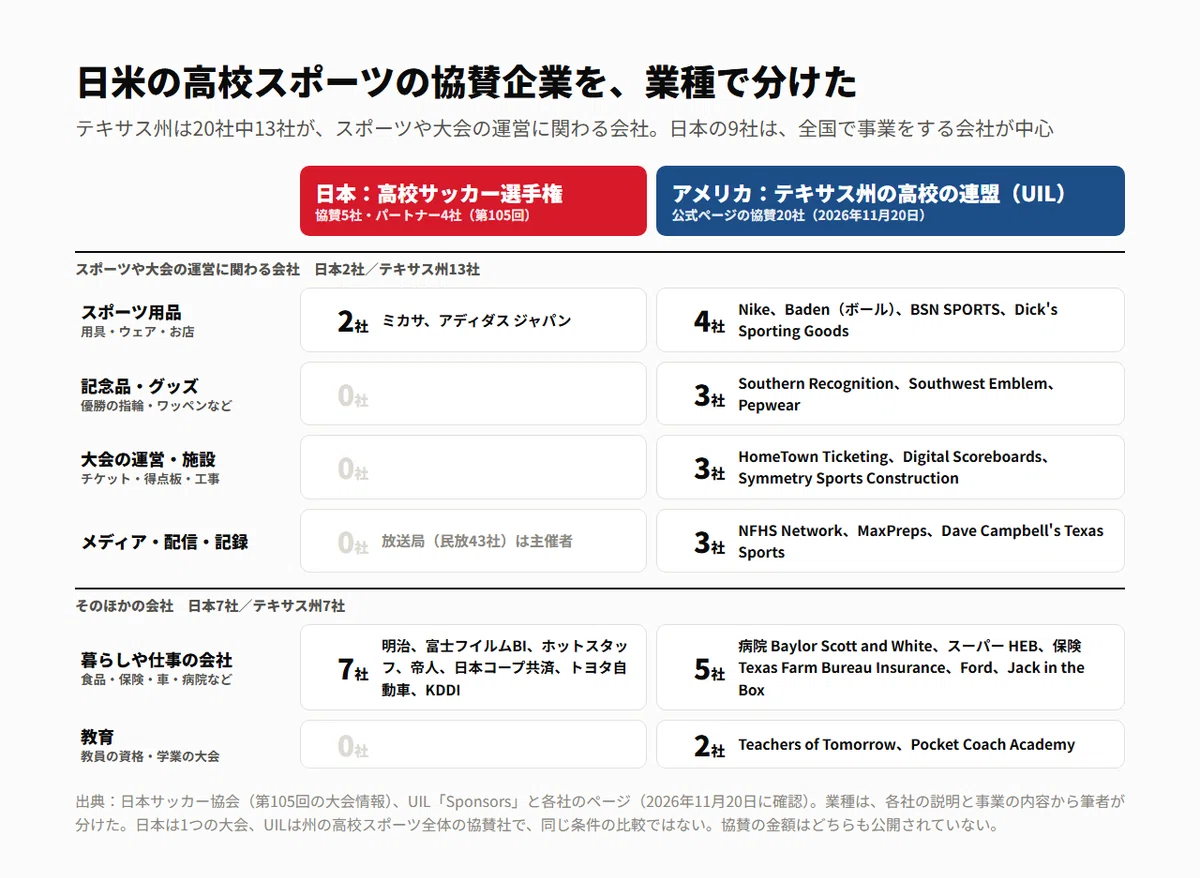
Texas was chosen because it is one of the most populous states in the US, and its state association publicly discloses a list of sponsors along with descriptions of each company. Since the UIL organizes state tournaments not only for high school soccer but also for other sports, UIL sponsors are sponsors of high school sports across the entire state. Please note that this is not an exact like-for-like comparison, as the nine Japanese companies sponsor a single event, the All Japan High School Soccer Tournament.
I categorized the industries into six groups based on each company’s description and business activities.
Result: A Significant Difference in the Lineup of Sponsors Between Japan and Texas
-
Sporting Goods (Equipment, Apparel, Retail): 2 Japanese companies (Mikasa, Adidas Japan) / 4 Texas companies (Nike, Baden, BSN SPORTS, Dick’s Sporting Goods)
-
Commemorative Goods & Merchandise: 0 Japanese companies / 3 Texas companies (Southern Recognition for championship rings, Southwest Emblem for patches and memorabilia, Pepwear for merchandise and apparel)
-
Tournament Operations & Facilities: 0 Japanese companies / 3 Texas companies (HomeTown Ticketing for online ticketing, Digital Scoreboards for scoreboards, Symmetry Sports Construction for athletic facility construction)
-
Media, Broadcasting & Records: 0 Japanese companies (broadcasters serve as organizers) / 3 Texas companies (NFHS Network for streaming, MaxPreps for game statistics, Dave Campbell’s Texas Sports for a Texas high school sports magazine)
-
Daily Life & Business Services: 7 Japanese companies (Meiji, FUJIFILM Business Innovation, Hot Staff, Teijin, Japan Co-op Insurance, Toyota Motor Corporation, KDDI) / 5 Texas companies (Baylor Scott & White Health for healthcare, H-E-B for supermarkets, Texas Farm Bureau Insurance for insurance, Ford for automobiles, Jack in the Box for hamburgers)
-
Education: 0 Japanese companies / 2 Texas companies (Teachers of Tomorrow for teacher certification, Pocket Coach Academy for supporting academic competition coaches)
Distinction 1: In Texas, 13 Out of 20 Companies Are Involved in ‘Sports and Tournament Operations’
Among the 20 sponsor companies in Texas, 13 fall into the four categories of sporting goods, commemorative merchandise, tournament operations, and media. Among the 9 companies in Japan, only 2 were in sporting goods.
Many of the sponsors in Texas are businesses whose clients are schools and athletic departments. For example, the BSN SPORTS page notes that they have 130 sales representatives serving schools across all regions of Texas. Companies handling ticketing, scoreboards, and facility construction also count schools and tournaments as their clients.
Distinction 2: Local Hospitals, Supermarkets, and Insurance Providers Sponsor the ‘Pinnacle Tournaments’
Among the 5 ‘daily life’ companies in Texas, Baylor Scott & White Health, the supermarket chain H-E-B, and Texas Farm Bureau Insurance are all Texas-based organizations (H-E-B is headquartered in San Antonio, Baylor Scott & White in Dallas, and Texas Farm Bureau Insurance is, as the name suggests, a Texas insurer). On the UIL page, they are designated as official sponsors in the healthcare, supermarket, and home/auto insurance categories, respectively.
The same pattern can be seen in other states. In December 2025, the Florida High School Athletic Association (FHSAA) announced Baptist Health, a South Florida healthcare provider, as the exclusive medical partner for the state football championships.
Because the state championship is the pinnacle, businesses operating within that state—such as local hospitals and supermarkets—sponsor the premier high school sports tournaments of their respective states.
Distinction 3: Nationwide Companies Also Enter Contracts State by State
Companies operating nationwide also sign individual contracts with state associations.
Nike is listed as a sponsor of the Texas UIL and also announced an official athletic apparel partnership with Florida’s FHSAA in November 2025. It was announced in March 2025 that Ford expanded its sponsorship of Texas UIL state championships under the banner of ‘Ford and the Texas Ford Dealers.’ This represents a model where a national company sponsors alongside local dealerships.
Because there are no national tournaments, national companies looking to gain exposure in high school sports across the United States must secure separate contracts state by state. There are 51 state associations affiliated with the NFHS across the 50 states and Washington, D.C.
The 9 Japanese Companies Are All Nationwide Businesses
Meanwhile, although the 9 companies sponsoring Japan’s High School Soccer Tournament span a variety of sectors—food, materials, office equipment and IT, staffing, mutual insurance, automotive, telecommunications, and sporting goods—every one of them operates on a nationwide scale.
Furthermore, in Japan, media companies participate as organizers rather than sponsors. In Texas, streaming and record-keeping companies were involved as sponsors. In other words, the structure of tournaments itself is fundamentally different, including who holds the rights to the event and who broadcasts it.
Interpreting Through the Three Stages of Sponsorship Effects
From here on, this is my own interpretation. I view the effects of sponsorship in three stages: “exposure,” “emotional shift,” and “contribution to core business.”
Japan’s National Tournaments: Easy to Aim for Exposure and Emotional Shifts
The All Japan High School Soccer Tournament is organized by broadcasting stations nationwide, and over 60,000 spectators gathered for the previous final. In my view, it is a tournament well-suited for companies operating nationwide to get their name out across the country (exposure) and earn goodwill as a business that supports high school students (emotional shift).
State Tournaments in Texas: Contribution to Core Business and Local Emotional Shifts
Many of the sponsors in Texas are companies that sell goods and services to schools and athletic departments. For these businesses, sponsoring state associations also serves as a venue to connect with schoolteachers and coaches. I see this as a form of sponsorship closely aligned with “contribution to core business.”
Local hospitals, supermarkets, and insurance providers take a form where they become known to customers within the state as companies supporting local high school students. I view this as sponsorship aimed at generating a local “emotional shift.”
Two Models: The “Nationwide Reach Model” and the “Local Pinnacle Model”
To summarize up to this point, I believe there are two models when it comes to sponsoring high school sports.
-
The Nationwide Reach Model (Japan’s All Japan High School Soccer Tournament): Spectators, broadcasts, and sponsorships concentrate on a single national tournament. Companies operating nationwide promote their names across the country.
-
The Local Pinnacle Model (US State Tournaments): A premier tournament exists in each state. Local businesses and companies serving schools enter the pinnacle tournament of that state. Nationwide companies layer contracts state by state.
In Japan, what comes close to the “Local Pinnacle Model” is, in my view, prefectural tournaments. Prefectural tournaments are broadcast by local television stations and feature local high schools. However, when I checked for the November 3 article, I was unable to find sponsors for prefectural tournaments in publicly available materials.
05 Business Implications: Three Steps to Apply High School Sports Sponsorships to Your Company
What You Will Learn in This Chapter: How your company can apply the “Nationwide Reach Model” and “Local Pinnacle Model” when sponsoring high school sports
Here, I summarize three steps for applying the analysis so far to your own business.
Step 1: Determine the Geographic Scope of Your Customers
The first thing to determine is the geographic reach of the customers you want to reach with your brand name through sponsorship.
-
If your customers are nationwide, national tournaments become viable candidates.
-
If your customers are concentrated in a single prefecture or region, prefectural tournaments or local schools become candidates.
-
If you do business in the US, the states where your stores or locations are based serve as the operational unit
I believe hospitals and supermarkets in Texas sponsor state tournaments rather than national ones because their customers are within the state. Even for regional Japanese companies, prefectural tournaments may sometimes be closer to their customer base than national tournaments.
Step 2: Decide where to place your sponsorship objective among the three stages
Next, decide what you aim to achieve through sponsorship across three stages.
-
Exposure: Getting your name widely recognized. Large tournaments with big audiences and broadcasts are suitable for this.
-
Shifts in sentiment: Gaining goodwill as a company that supports local high school students. Tournaments in the same region as your customers are suitable for this.
-
Contribution to core business: If you do business with schools or athletic clubs, you can use this as an opportunity to connect with teachers and coaches. I believe sponsorships by sporting goods, ticketing, and facility companies in Texas are close to this model.
I believe national tournaments like the High School Soccer Championship are well-suited for exposure and shifts in sentiment. For companies that do business with schools, engaging with regional federations or tournaments may tie into their core business more effectively than sponsoring a national tournament.
Step 3: Decide on the tournament level and who to talk to
Finally, decide which level of tournament to get involved with, and whom to speak with.
-
National tournaments in Japan: The High School Soccer Championship is organized by the Japan Football Association and 43 commercial broadcasting companies.
-
Prefectural tournaments in Japan: These tournaments are often broadcast or streamed by local television stations. Sponsorship structures vary by prefecture, and since public materials are scarce, you would need to inquire directly with the organizations running the tournaments or the local TV stations broadcasting them.
-
State tournaments in the US: State high school athletic associations serve as the point of contact. Depending on the state, they outsource sponsorship sales to separate companies. For instance, the Florida association lists a company named TPG as the agency handling sponsorships. If you want nationwide exposure, you must layer contracts state by state.
In the US, there are also tournaments where private companies invite top high schools from across the country, some of which are broadcast on ESPN. However, the NFHS asks invited schools to carefully consider whether or not to participate in these tournaments. I believe that sponsors should also verify how schools and state associations view those tournaments.
Sponsorship costs and effectiveness remain hidden from the outside
Finally, here are the limitations of the information used in this article. Neither the High School Soccer Championship nor the Texas association discloses sponsorship amounts. Nor were figures showing sponsorship effectiveness found in public materials.
What this article reveals is limited to the lineup of “what kinds of companies sponsor tournaments at which levels” and the structural differences between tournaments. Even so, I believe it provides useful reference material in the initial stage of selecting sponsorship opportunities to decide whether you want to reach a national audience or integrate into the pinnacle of the local scene.
In Quastats’ sponsorship series, we build up overseas case studies into practical benchmarks that Japanese companies can use. If you would like to keep reading, we would appreciate it if you followed us.
Here are some previously published articles related to this piece.
Here is an article examining how much prefectural preliminary rounds of the High School Soccer Championship are viewed on local TV stations’ YouTube channels.
Click here for an article comparing Japanese and US studies on how to measure sponsorship effectiveness across three stages: “exposure,” “emotional shift,” and “contribution to core business.”
We will continue to share insights on US college sports and sports sponsorship based on data and official information. Thank you very much for reading to the end.
