

With voter anger over rising prices, a controversial war and an unpopular president, Republicans are bracing for big losses in the midterm elections. That’s especially true in deep blue Massachusetts, where for years, the state GOP has struggled to rebuild the fragile coalition that once made it competitive.
“The party’s struggling,” said Wendy Wakeman, a longtime Republican strategist in Massachusetts.
One of the Republican candidates pushing against those stiff headwinds is Micah Jones. He’s running for the congressional seat being vacated by Democrat Seth Moulton, hoping to become the state’s first Republican member of the U.S. House in 30 years.
Jones argues that in a time of deep political division it’s time “to lower the political temperature.”
“Politicians in both parties, I think, have engaged in a sort of rhetoric and combativeness that I don’t think is healthy for the country,” he told WBUR on a recent afternoon in his hometown of Essex on Cape Ann.
Jones, a 38-year-old securities attorney and Army combat veteran, describes himself as a former “JFK Democrat” who switched parties almost 10 years ago because he felt the Democratic Party had moved too far to the left. He supported Hillary Clinton in 2016, but then voted for Donald Trump in 2020 and 2024.
Jones said he thinks he’s the kind of Republican who can succeed in Massachusetts, invoking the ghost of the state’s “Yankee Republican” tradition.
For decades, Massachusetts voters frequently elected Republican politicians who offered a blend of fiscal conservatism and social moderation — a tradition embraced by Govs. Leverett Saltonstall, William Weld and Mitt Romney. Jones noted that former Gov. Charlie Baker and former Lt. Gov. Karyn Polito, the last two Republicans to win statewide election in Massachusetts, have endorsed him.
“The Baker-Polito administration set the gold standard when it came to bipartisanship, always placing the needs and priorities of Massachusetts ahead of rote party ideology,” he said.
Jones argues that Massachusetts would be better off with at least one Republican in Congress who could work with Democrats and the Trump administration. But his Democratic opponent, Dan Koh, who worked for former Boston Mayor Marty Walsh and President Joe Biden, rejects Jones’s call to cool tensions.
“I think the temperature needs to be raised against this president and the agenda that we’re seeing,” Koh told WCVB’s On The Record. Koh added that while he respects Jones’s military service, he does not respect his votes for Trump.
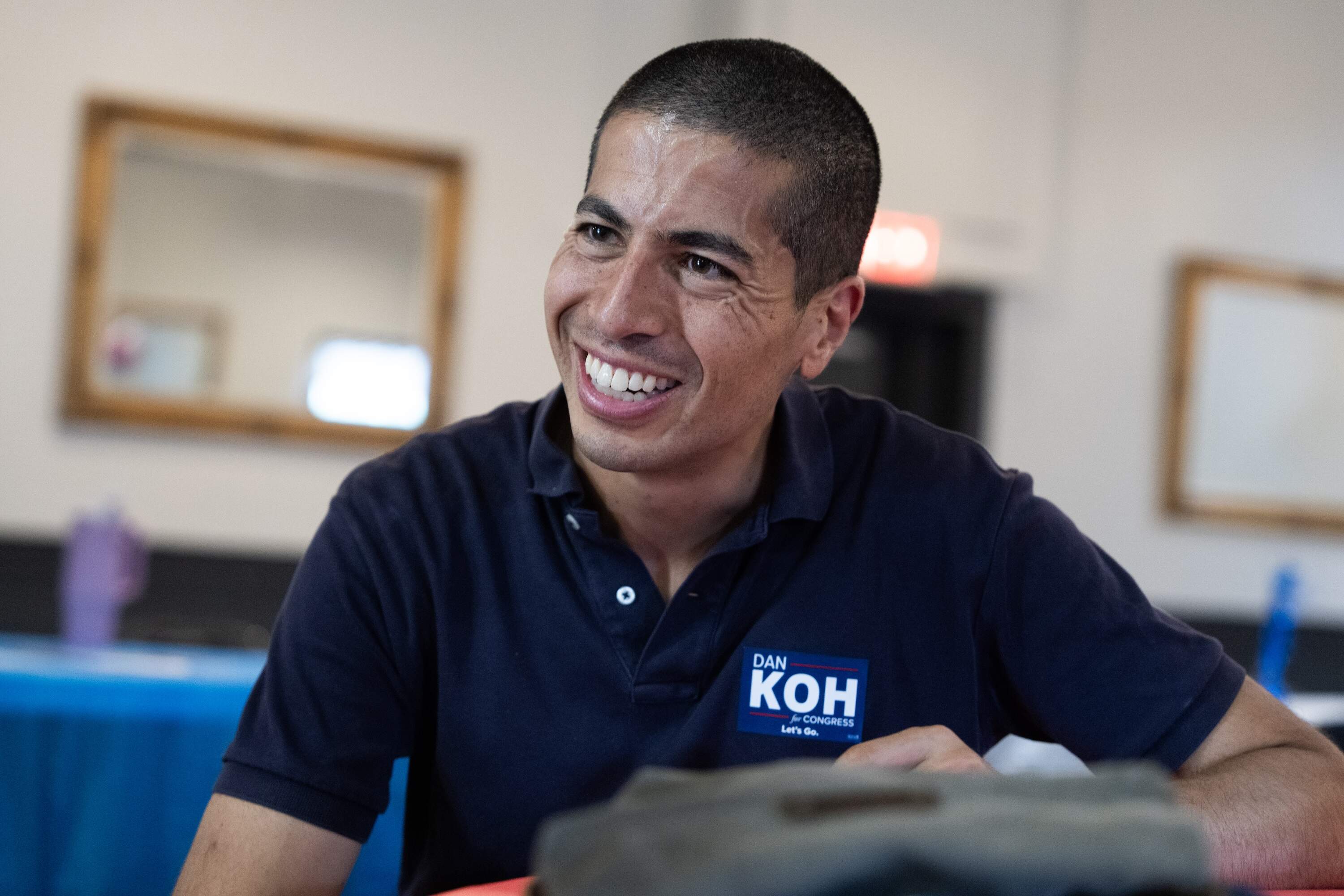
With the president’s approval ratings at historic lows, Koh and other Democrats are eager to tie their Republican opponents to the national party brand.
“It’s clear that there is a national current that is making it challenging for Republicans running, not only here in Massachusetts, but across the nation,” said Amy Carnevale, chair of the Massachusetts GOP.
The challenges besetting the state’s Republican party have been years in the making.
It continues to face financial challenges, including more than $330,000 in debts. At the same time, its membership has atrophied — fewer than 9% of Massachusetts voters are registered Republicans. All of the statewide offices — from governor to treasurer to auditor — are controlled by Democrats, and Democrats also enjoy supermajorities in both branches of the Legislature.
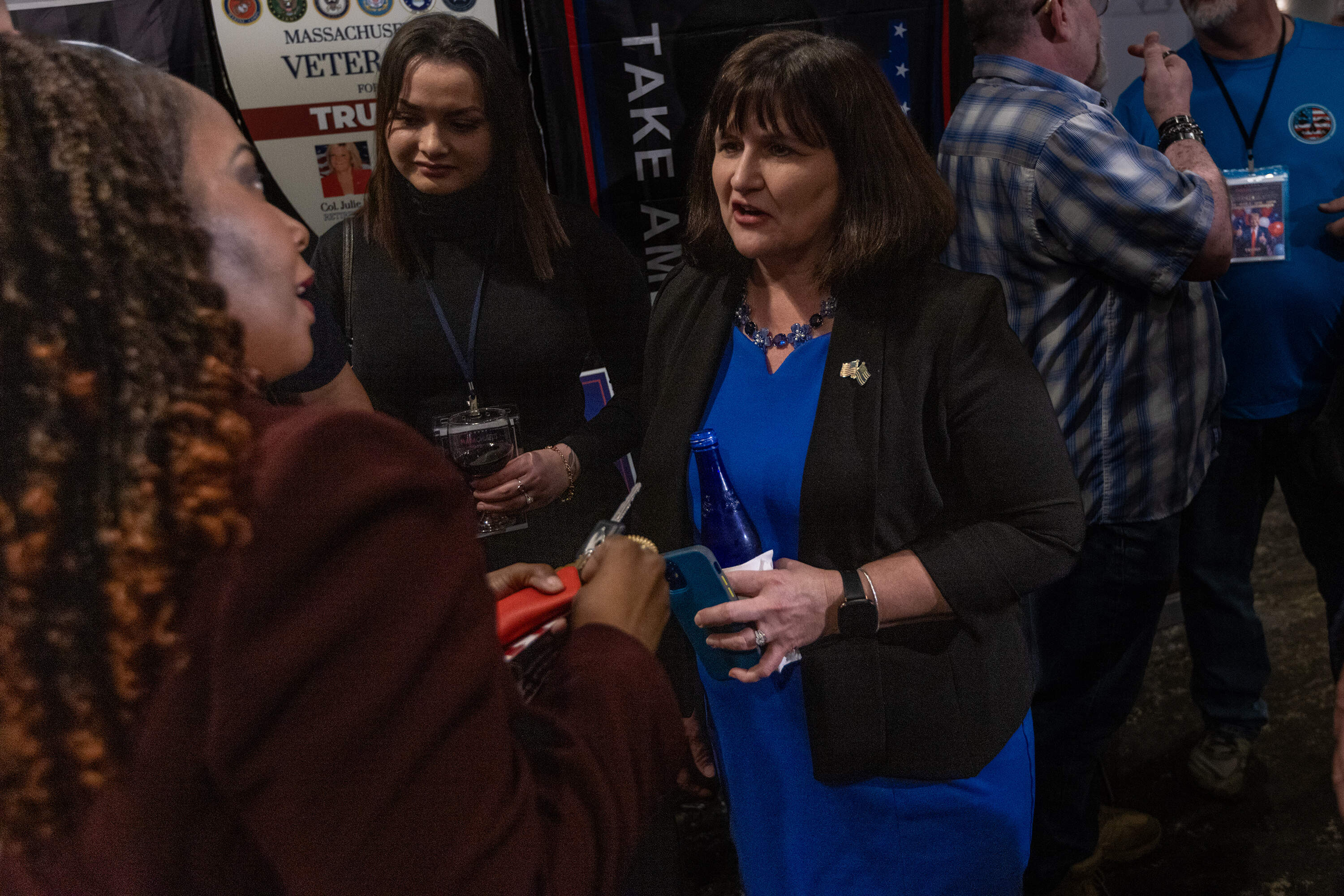
Wakeman, the strategist, said the state’s Republican party has struggled to raise money and recruit candidates.
In the State House, Republicans are on the ballot in fewer than a third of the 160 seats in the House, and only 11 of 40 in the Senate. At the same time, three of the nine congressional races with Democratic incumbents have no Republican challengers. According to Wakeman, the biggest challenge is not having a Republican governor to lead the charge.
“Without that, the party flounders, factions fight, fundraising is difficult, and candidates don’t want to stand up and run for office,” she said.
Without the support of a robust party infrastructure behind them, the entry requirements for Massachusetts Republicans have drastically shifted. According to Anthony Amore, who ran for state auditor as a Republican in 2022, the only Republicans who can launch viable statewide campaigns are those rich enough to finance them themselves. Amore points to this year’s Republican primary contenders for governor — Mike Kennealy, Brian Shortsleeve and Mike Minogue — all of whom spent large sums of their own money to run their campaigns.
“They’re all good men, but they are all multi-millionaires,” Amore said.
Without that kind of personal wealth, Amore said running statewide is a “non-starter,” adding, “that’s not a good thing for the state … or democracy.”

Even after pouring more than $15 million of his own fortune into the race, Minogue, the winner of the Republican gubernatorial nomination, faces a steep climb. He trails Gov. Maura Healey in the polls — and his gubernatorial bid was deeply destabilized when his running mate, Shawn Oliver, crashed his car and was charged with drunk driving, leading Oliver to suspend his campaign for lieutenant governor.
But Amore said the structural hurdle is simpler: Healey’s highly disciplined strategy to link Minogue directly to national partisan politics.
“Democrats have been effective in using that approach,” he said. “Tie everybody to Trump.”
Amore noted that the strategy was on full display in the first debate between Healey and Minogue, when the governor invoked Trump’s name 35 times, “more than once every minute that she spoke.”
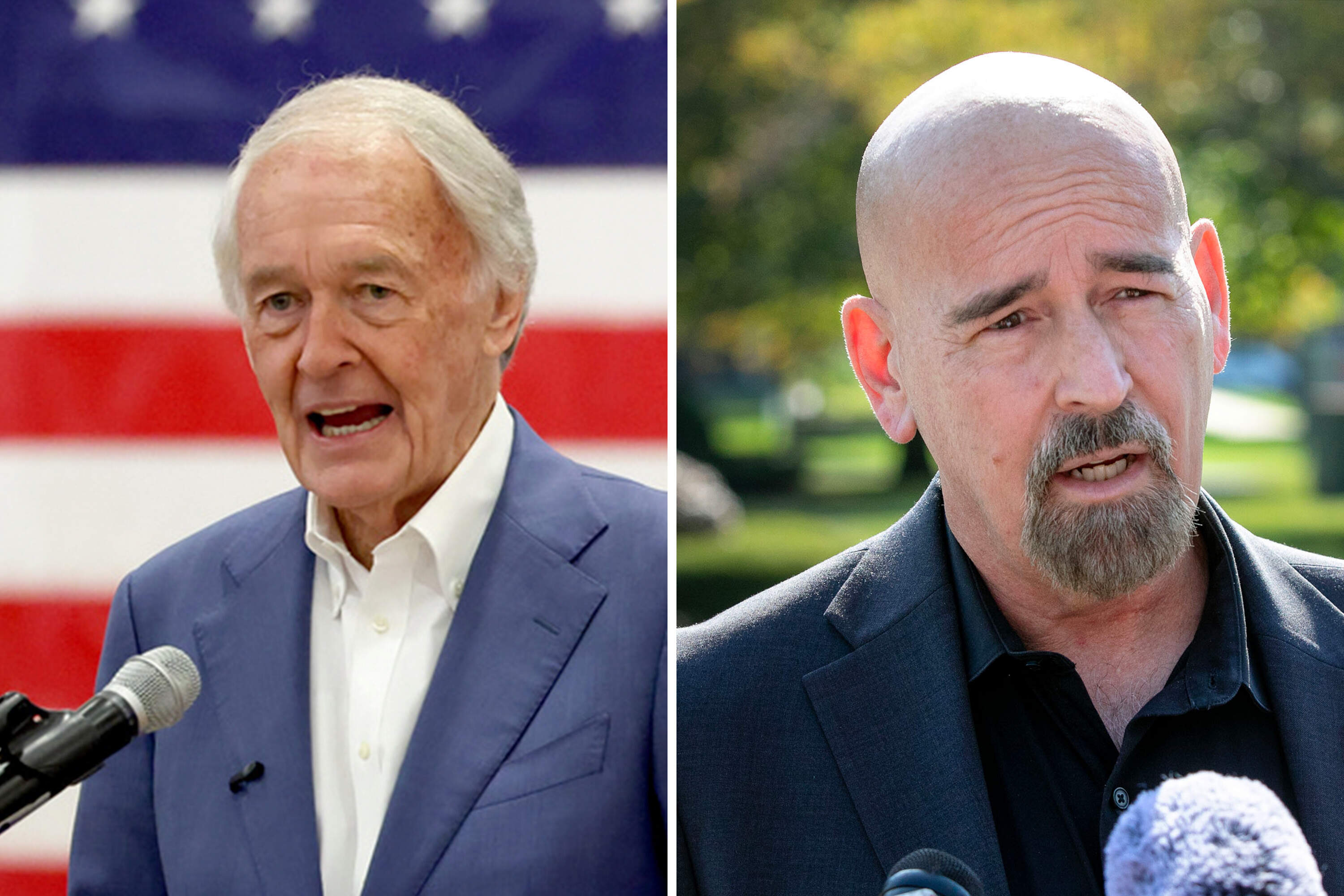
U.S. Sen. Ed Markey employed a similar strategy against his Republican challenger, John Deaton, who’s making his second run for the U.S. Senate — after losing to Sen. Elizabeth Warren two years ago.
“I’m going to Washington to be a check on Donald Trump. Mr. Deaton is going to Washington to be a blank check for Donald Trump,” Markey said in their only debate, in which he repeatedly referenced the president.
Deaton, who’s running as a non-MAGA, moderate Republican, accused Markey of mis-representing him. But he acknowledged the difficulty of running as a Republican in Massachusetts with Trump in the White House.
“The challenge for me is to get people to look beyond the [Republican] label. But it is a big hurdle,” Deaton told WBUR.
In a state that has rejected Trump by consecutive 2-1 margins, the focus on national politics is a death sentence for local Republicans. It helps explain why Election Day could be a difficult day for them — and why the Massachusetts Republican Party is still struggling to find its way out of the political wilderness.
