

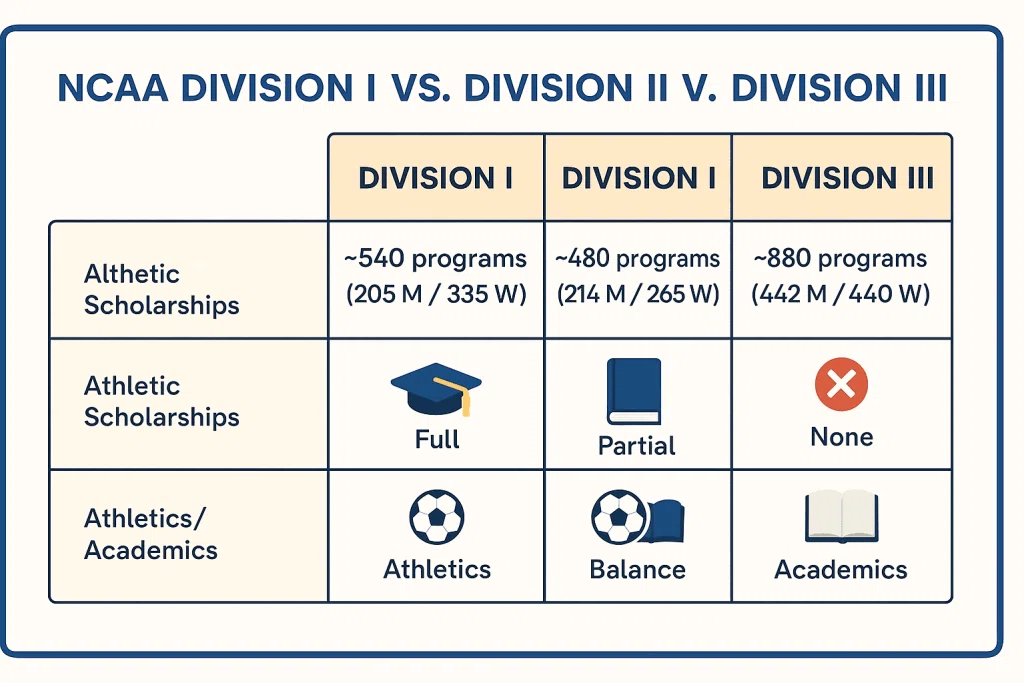
Division II, which we covered last time, was a system that balanced competition, academics, and university management while utilizing partial athletic scholarships.
So, why does Division III, which does not offer athletic scholarships, work?
Without scholarships, top athletes won’t gather. The level of competition won’t rise. For universities, there is little point in having athletic departments—from a Japanese perspective, one might think so.
However, Division III is the division with the most participating universities in the NCAA.
For the 2025–26 academic year, there are 426 schools, consisting of 422 full members and 4 provisional members. Approximately 210,000 student-athletes belong to this division, accounting for about 37.7% of the entire NCAA. Member schools conduct an average of 19 sports per school, and the percentage of athletes among the total student body reaches an average of 31%.
It is not a “collection of small universities that cannot afford scholarships.”
It is a massive group of universities that intentionally chose a different set of rules to integrate sports into education and university life.
Division III is not “Third Division”
The names Division I, II, and III inevitably evoke a hierarchy of first, second, and third divisions.
However, NCAA divisions are not inherently a ranking based solely on competitive strength.
It is a difference in operating models regarding how much funding a university invests in sports, what kind of scholarships it provides, how much time is spent on competition, and what is prioritized within university education.
At the heart of Division III is not a philosophy that denies winning.
They do not change the university’s educational structure just to win.
The current NCAA philosophy prioritizes the quality of the educational experience and academic completion, positioning competition as part of the student’s educational experience. It also emphasizes the impact on the student-athletes themselves over entertainment for spectators.
Competition is taken seriously. However, competition does not override the purpose of the university. Division III is the institution that draws that boundary line. Even in Div3, there is their own “One Shining Moment.”
The true meaning of “no scholarships”
This is the most easily misunderstood part.
It is not that Division III students have absolutely no scholarships or financial aid.
What is prohibited is athletic scholarships awarded by the university based on athletic ability, athletic performance, or participation in sports.Students can utilize merit-based scholarships, need-based grants, internal and external aid, and student loans based on the same criteria as other students.
In other words, coaches can find talented athletes and encourage them to apply. However, they cannot offer special tuition discounts because of that athlete’s status.
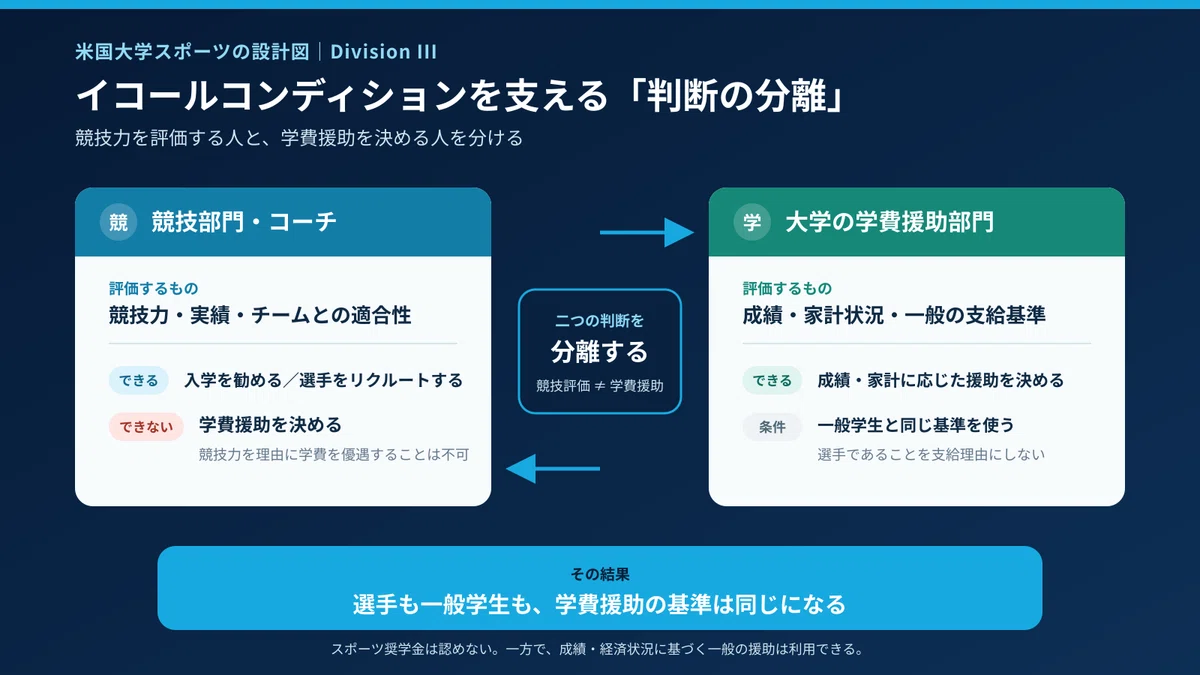
Separating the athletic department that evaluates players from the university’s financial aid system. This separation supports the level playing field of Division III.
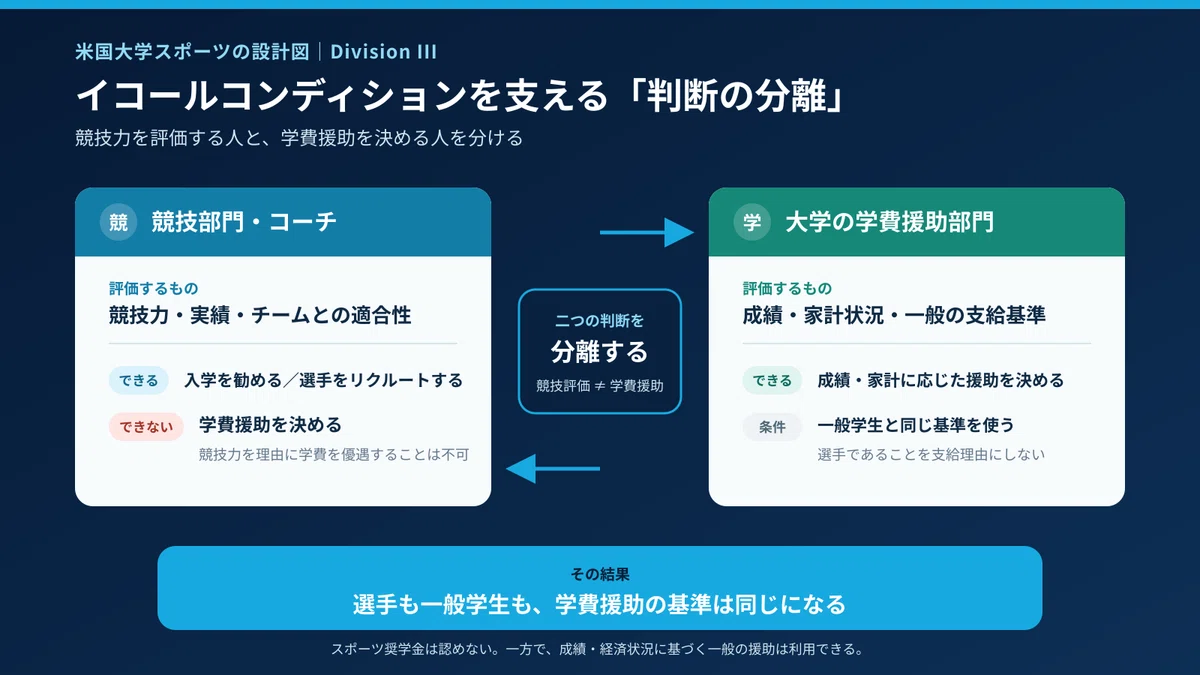
The absence of athletic scholarships does not mean the athletes lack value. It is a choice not to make sports the sole currency for tuition assistance.
Why students choose Division III today
Many students who choose Division III want to continue playing sports. However, they do not want their entire college life to be defined solely by sports.
Specialized fields, study abroad, research, internships, and student organizations.
They want to pursue the sport they have played since high school seriously while keeping those options open. In an era where it is difficult to define one’s future by a single title, this is a very natural desire.
The value of Division III is not in forcing a choice between “athletics or academics.”
It lies in not closing off options for college life while continuing to compete.
① “A place where I belong” over a “famous university”
When choosing a university, it is not just about name recognition or rankings, but whether you can find a place for yourself on that campus.
In Division III, the team becomes a community that connects students to the university even before enrollment. From the day they enter, they have relationships with teammates, upperclassmen, and coaches, making it easier to feel a sense of participation in the university.
According to an NCAA survey, 87% of Division III student-athletes responded that participating in sports helped them adapt socially to college, and 82% reported a sense of belonging to the university.
Athletics serves as an entry point for integrating into the university.
② Not being tied to a single title
There is a path where you build your career path around athletics. On the other hand, Division III promotes the value of being able to participate in research, student government, community activities, and career preparation while being an athlete.
According to an NCAA survey, 41% of former Division III student-athletes have earned graduate degrees or higher, surpassing the 37% of non-athletes. Additionally, 63% held leadership roles in campus clubs or organizations, and over 90% of students responded that their athletic experience had a positive impact on their sense of responsibility, collaboration, and goal setting.
What Division III promises is not a single-track road to becoming a professional athlete.
It is a college life where athletic experience can be translated into the next job or life stage.
③ Seeking both a high level of competition and space for life
Division III also has national championships, regional rivalries, and powerhouse programs. There are research and educational institutions like MIT and the University of Chicago, as well as universities that have long competed at the top of the national rankings in specific sports.
Students can maintain the intensity of competition without having to dedicate their entire college life to it.This is not a demand for ‘taking it easy.’ It is a demand for wanting to challenge oneself in multiple areas at a high level.
4. Consider tuition based on the total amount, not the ‘presence of athletic scholarships’
What is important for students and parents is not the name of the scholarship, but the final cost of attendance.
Division III does not offer athletic scholarships, but financial aid based on academic performance or household financial status is available. Therefore, there are cases where the final out-of-pocket cost is lower than in Division II, where athletic scholarships are offered.
When comparing the entire package—athletic opportunities, the major one wants to study, a place on campus, post-graduation paths, and the actual cost of tuition—Division III is chosen.
And there, a stage where one can shine in sports is properly prepared.
Why is Division III compatible with social media promotion?
Division III promotion does not just sell game results or star athletes.
Since 2010, the NCAA has been promoting the ‘Identity Initiative’ to enable member schools to explain the reasons for choosing Division III using a common language. During Division III Week, each university and conference introduces students not only through sports but also through academics, leadership, community service, and campus participation.
The ‘#WhyD3’ hashtag, often used on social media, is a symbol of this.
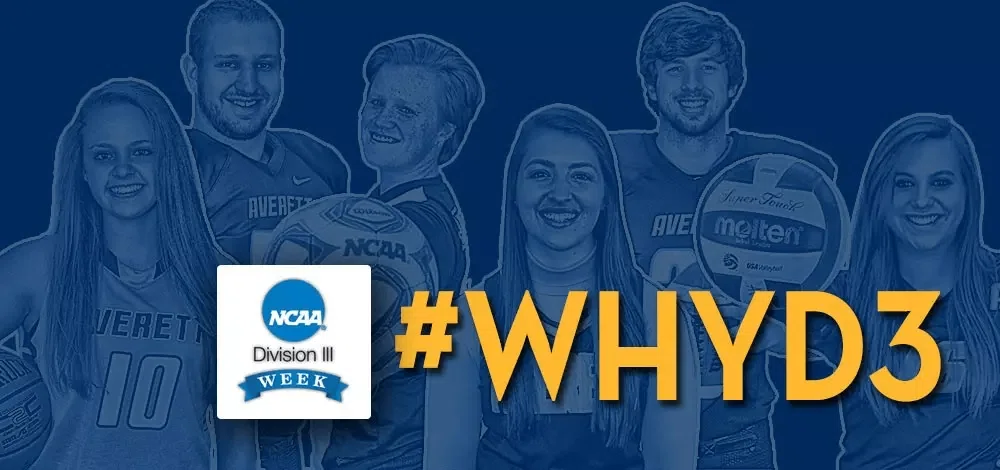
Not just game highlights, but laboratories, internships, community activities, daily life with teammates, and post-graduation careers all become content for dissemination.Through short videos or posts by the athletes themselves, high school students can get a sense of ‘a day after enrollment’ or ‘the friends they will meet,’ which are hard to see in official brochures.
Division III has 426 schools with an average of 19 sports. Thousands of teams share their own stories, and universities, conferences, and the NCAA bundle them under a common brand.
In other words, the promotional power of Division III does not come from having one giant media outlet.
It comes from the power to consolidate countless small, firsthand accounts into a single narrative: ‘The reason for choosing Division III.’
Why it works as university management
So, what does this mean for the universities?
The average number of undergraduate students at Division III member schools is 2,535, and 80% are private universities.
Looking at the figure that student-athletes account for an average of 31% of the total student body, sports are not extracurricular activities on the periphery of the university. They are a mechanism that shapes the student composition itself.
Even at member schools without football, the median number of student-athletes is 321. At universities with football, it reaches 619. For universities with a few thousand students, this number cannot be ignored in terms of management.
For many small colleges, athletic departments are not only a gateway for student recruitment, but they also create a sense of belonging after enrollment, support retention and graduation, and serve as a point of contact with parents, alumni, and the local community. Therefore, their value cannot be measured solely by the question of whether the athletic department itself is profitable.
The impact on university management needs to be considered in terms of the following structure.
By utilizing existing facilities and shared staff, if an appropriate number of students are recruited and those students remain enrolled until graduation, the university as a whole can be sustainable even if the athletic department’s individual ticket revenue is small.
In other words, Division III sports are evaluated not just by attendance numbers, but by how many students enroll because of the sport, stay at the university and graduate, whether that experience leads to further education or employment, and whether the students’ stories reach the next group of applicants.
The team brings students to the university. The learning and daily life they experience there reach the next generation of high school students through social media and other channels. Here, there is a structure where recruitment, education, retention, and public relations circulate.
The reason students choose the university becomes content that conveys the university to the next group of students.
On the other hand, it is not necessarily true that simply increasing the number of team members will improve university management. General scholarships, tuition discounts, coaching salaries, facilities, travel, and safety management costs are all necessary. If you maintain a large roster just for the sake of student recruitment, playing opportunities, coaching, and safety management will be diluted, and you will not be able to provide the athletic experience the students expected.
The condition for Division III to work is not that it does not offer scholarships.
It is the ability to design an athletic department based on four factors: recruitment numbers, educational impact, student experience, and costs.
Where does the money come from?
Division III team operating expenses are basically covered by each university’s general budget, tuition revenue, student-related fees, donations, endowments, local sponsorships, and ticket sales. Unlike some parts of Division I, it is not a model supported by massive broadcasting rights fees or conference distributions.
The NCAA headquarters does not uniformly distribute daily team operating expenses to universities.
However, the NCAA supports national championships and common infrastructure.
The revenue distribution to Division III for the 2025–26 academic year is approximately $46.68 million, which is funded by 3.18% of the NCAA’s operating revenue. For the same fiscal year, expenditures from excess reserves were also approved, with approximately $38.3 million allocated to championships and approximately $12.2 million allocated to the Enrichment Fund for conference support, student support, health and safety, and leadership development.
In other words, while each university bears the burden of its own daily activities, they collectively maintain national championships, insurance, rule-making, educational programs, and safety management, which are difficult to provide individually.
This is also the essence of the NCAA.
A portion of the revenue generated by the entire NCAA is directed toward common infrastructure, maintaining the foundation of competition for all member schools.
Even without scholarships, the quality of play can be maintained.
Without athletic scholarships, it might seem that competition would become lax. However, in reality, they have not just eliminated scholarships, but have created a framework where schools can compete under the same conditions.
There are NCAA restrictions on competition seasons and practice activities, and selection criteria for national championships are also established. Conference structures centered on regions create ongoing rivalries while keeping travel costs and class absences to a minimum. Member schools have an average of 19 sports, providing a wide range of students with the opportunity to compete on representative teams.
As a result, rather than concentrating resources on a few star athletes, many students compete in an environment with a consistent standard.
An equal playing field does not mean making all universities the same size.
It is about sharing boundaries on what money can be spent on and how much time can be dedicated to athletics.
The Choice Not to “Move Up”
Universities that succeed in Division III do not necessarily aim for Division II or I. Winning in sports and moving to a higher division are separate decisions.
In fact, there has been a movement in the opposite direction in recent years. Immediately after advancing to the 2025 NCAA tournament in Division I men’s basketball, Saint Francis University chose to transition to Division III starting in the 2026–27 academic year.
The reasons cited by the university included the complexity of the systems and costs surrounding Division I, long-distance travel due to wide-area conferences, time away from classes and campus life, and alignment with the university’s educational philosophy.
Even if a university has the competitive ability to participate in national tournaments, it does not mean that is the right model for the institution.
This is not a “demotion.” The university has simply re-chosen what success means for them.
What Division III Protects
Division III does not take winning lightly.
It ensures that students who aim to win do not have to give up their academics, friendships, community activities, or career preparation. To that end, they accept common constraints among universities.
Not every university needs to have a massive stadium or broadcast rights revenue. Not every athlete needs to aim for the pros. However, a stage can be created where one can compete in earnest while representing their own university.
It does not force every university to pretend they are aiming for a national championship.
Even so, it leaves a path to the championship for students who truly aim to win a national title.
I believe that making these two things coexist is the strength of Division III.
However, the gateway to US college sports is not limited to four-year universities.
Next time, as a special edition, I would like to cover the NJCAA, which is organized primarily around two-year colleges.
Why do promising athletes choose community colleges or junior colleges instead of going to an NCAA university from the start? How do tuition, academic requirements, playing opportunities, and athletic scholarships play a role? And within the US system, where transferring is built in as a premise, how do athletes climb up to four-year universities, and sometimes even to the top level?
Junior colleges are neither a dead end nor just a detour. They are another starting point for moving on to the next opportunity.
Following this, in Part 4, we will move on to the NAIA, a national organization for four-year universities that is different from the NCAA.
