


The general manager at the Massachusetts Bay Transportation Authority is responding to an NBC Boston investigation about a man who died after getting caught in an escalator at the agency’s Davis Station in Somerville, Mass.
As first reported on Tuesday, Steven McCluskey died days after first responders freed him from the machinery and transported him to the hospital.
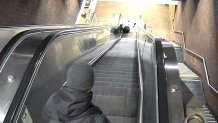
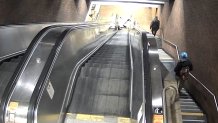
McCluskey stepped on the escalator just before 5 a.m. on Feb. 27. Surveillance video NBC10 Boston obtained showed that McCluskey was at the bottom of the moving escalator for more than 20 minutes before an MBTA employee pressed the emergency stop button.
MBTA
MBTA Steven McCluskey on the escalator
After a public meeting at the State Transportation Building in Boston, NBC10 Boston asked General Manager Phil Eng what his reaction was when he learned about the incident.
“Obviously, this is a tragedy,” Eng said. “Safety, reliability of the system, is paramount. We certainly understand that this was an unfortunate incident for this gentleman, and his passing is something that is very disheartening.”
Eng said the agency reviewed the circumstances of the deadly incident. After the rescue inside the T station, he said workers inspected the escalator and returned it to service without any mechanical issues.
Eng also said the official on duty had just opened the station and was going through a long checklist of items to prepare for the busy morning rush. Payroll records NBC10 Boston requested show the inspector clocked in at 4:45 a.m.
The family of Steven McCluskey is demanding accountability after his death at Davis Station in Somerville.
When asked if there should be more staff at the station, Eng said that still wouldn’t guarantee an employee would be near the escalator at that moment.
“This is where we need the public to support us,” Eng said. “Help one another. Speak up. Let us know, alert us to it. That’s the way we can not only make sure riders are safe, but one day, you might need that help.”
A deadly escalator incident is rare, but it’s not unheard of at the MBTA.
In 2009, news articles described how an elderly Dorchester woman was killed when her clothing was caught in an escalator at the State Street station and wrapped around her neck.
Surveillance video shows the moment man became stuck in an escalator in the MBTA David Square station, struggling to get free as people walked by. He died of his injuries.
Four years earlier, a 34-year-old man died at the Porter Square station when the hood of his sweatshirt got entangled in an escalator.
The surveillance video NBC10 Boston obtained revealed more than a dozen people passed by McCluskey while he was laying at the bottom of the moving escalator. None of them pressed the emergency stop buttons or appeared to call for help.
“He was a somebody. He had a life. We loved him. They treated him like he didn’t exist,” Mary Flaherty, McCluskey’s mother, told NBC10 Boston after viewing the footage. “Nobody cared. Nobody stopped. Nobody took the time to help, to make sure that he was OK. If somebody took that minute, he would be here today.”

NBC10 Boston
NBC10 Boston Steven McCluskey’s mother, Mary Flaherty, and sister, Shannon Flaherty
The death remains under investigation by the Middlesex County District Attorney’s Office, which is awaiting a cause and manner of death ruling from the medical examiner.
Catherine Sanderson is a psychology professor at Amherst College who wrote a book called, Why We Act, which explores the reasons that bystanders fail to step up during emergencies.
Sanderson believes a couple of common factors came into play with McCluskey’s situation.
For one, she said there can be ambiguity about whether something is actually an emergency. People might perceive someone is drunk or on drugs and look at other people’s faces to see if they are reacting to the situation, she explained.
MBTA
MBTA
MBTA
MBTA
Sanderson said bystanders can worry that it isn’t their responsibility to get involved or assume someone else in a public place will take charge — a concept known as “diffusion of responsibility.”
“A single person stepping up would’ve made a difference,” Sanderson said. “Break the silence and speak up, even to a stranger. One person often creates a cascade of help, and this situation, I fear, could’ve turned out very differently.”
Sanderson said what she observed in the video is common human behavior, despite a litany of online comments that are criticizing their inaction or questioning their moral compass.
Ryan Kath of the NBC10 Boston Investigators talks about his report on a man who died after being caught in an escalator, with video showing more than a dozen riders pass him by. The escalator kept running until an employee hit the emergency stop button 22 minutes later.
From people she has spoken with throughout her career as a psychologist, Sanderson said there will be lingering effects.
“Those people are feeling horrible, and I hate to say it, but they’re going to feel horrible for a while,” Sanderson said. “Again and again, it haunts people. And I’m telling you, they are thinking about it and they will think about it for the rest of their lives.”
