

Introduction
What you will learn in this chapter: Who this article is for and what you will understand after reading it
*Articles I have written previously that are relevant to this one are introduced at the end of this article.
Hello. I share information about US college sports and sports sponsorships based on data and official sources.
When your child says, “I want to play sports at a US university,” and you start researching, you will immediately run into unfamiliar terms. NCAA, Division 1, athletic scholarships, and the recent news about “universities paying athletes.”
Moreover, the rules for US college sports changed significantly starting in 2025. Experiences and blog posts about studying abroad from a few years ago may no longer apply.
Therefore, in this article, I will use the most recent official figures released by the NCAA and others to explain the overall picture of US college sports from scratch. I will break down difficult terms as they appear.
What you will learn in this article
-
What is the NCAA? What is the difference between Division 1, 2, and 3?
-
What percentage of high school athletes in the US can play in college?
-
How does the scholarship system differ by division?
-
The “roster limits” that changed starting in 2025 and money from universities to athletes
-
The first step when aiming from Japan and questions to ask university coaches
The information in this article is current as of October 24, 2026. Since rules may continue to change, please be sure to check official guidance from the NCAA or the university when actually deciding on your path.
Chapter 1: What is the NCAA? 1,074 schools divided into ‘Division 1, 2, and 3’
What you will learn in this chapter: The organization that manages US college sports and its scale
The NCAA is the organization that manages US college sports
The NCAA (National Collegiate Athletic Association) is the organization that determines the rules for US college sports games, the conditions for athletes to participate in games, and national championships. It is easy to imagine it as an organization that consolidates the various university athletic leagues in Japan into one.
According to the NCAA, there are 1,074 member schools (as of September 2026, active schools). These 1,074 schools are divided into three ‘divisions’.
-
Division 1: 361 schools
-
Division 2: 297 schools
-
Division 3: 416 schools
There are 550,000 athletes. Division 3 is the largest.
The number of athletes playing at NCAA universities is 554,298, the highest ever (2024-25 academic year, per NCAA announcement). Looking at it by division, it is as follows.
-
Division 1: 202,353 athletes
-
Division 2: 141,067 athletes
-
Division 3: 210,878 athletes
When you hear ‘American college sports,’ you tend to think of Division 1 with its large stadiums seen on TV. However, in terms of numbers, Division 3 is the largest.
Differences between Division 1, 2, and 3
Roughly speaking, the three divisions differ as follows:
-
Division 1: Considered to have the highest level of competition, with many large-scale universities. Games are often broadcast on TV.
-
Division 2: Many universities are smaller in scale than Division 1. Athletic scholarships are available, but most are ‘partial’ (explained in Chapter 3).
-
Division 3: No athletic scholarships. It is said that many universities prioritize the balance between academics and student life.
I believe it is better to think of this as a choice based on ‘what kind of college life you want to lead’ rather than ‘which division is superior.’
The number of programs varies by sport
According to NCAA projections for the 2026-27 academic year, for example, the following number of universities have programs (total of Division 1, 2, and 3).
-
Women’s Soccer: 1,026 schools (including 349 in Division 1)
-
Men’s Soccer: 823 schools (including 213 in Division 1)
-
Baseball: 940 schools (including 309 in Division 1)
-
Men’s Basketball: 1,070 schools (including 365 in Division 1)
-
Women’s Volleyball: 1,053 schools (including 348 in Division I)
Knowing how many universities have a team in your sport will help you visualize the breadth of your options for your future path.
There are paths other than the NCAA
In the United States, besides the NCAA, there is an organization called the NAIA, which includes smaller universities, as well as an organization for two-year community colleges (NJCAA). The NCAA is not everything. This article focuses primarily on the NCAA, which is the largest.
Chapter 2: What percentage of high school athletes can play in college?
What you will learn in this chapter: The percentage of US high school athletes who advance to college sports and how to interpret those figures
About 560,000 out of approximately 8 million
Every year, the NCAA estimates and publishes data on “how many high school athletes in the US go on to play for NCAA universities.”
According to the latest estimates (2024-25 academic year), there are approximately 8 million high school athletes in the US. Of those, about 560,000 play for NCAA universities.
We have summarized the percentages for each sport (the ratio of high school athletes who play in the NCAA) for major sports in a chart.
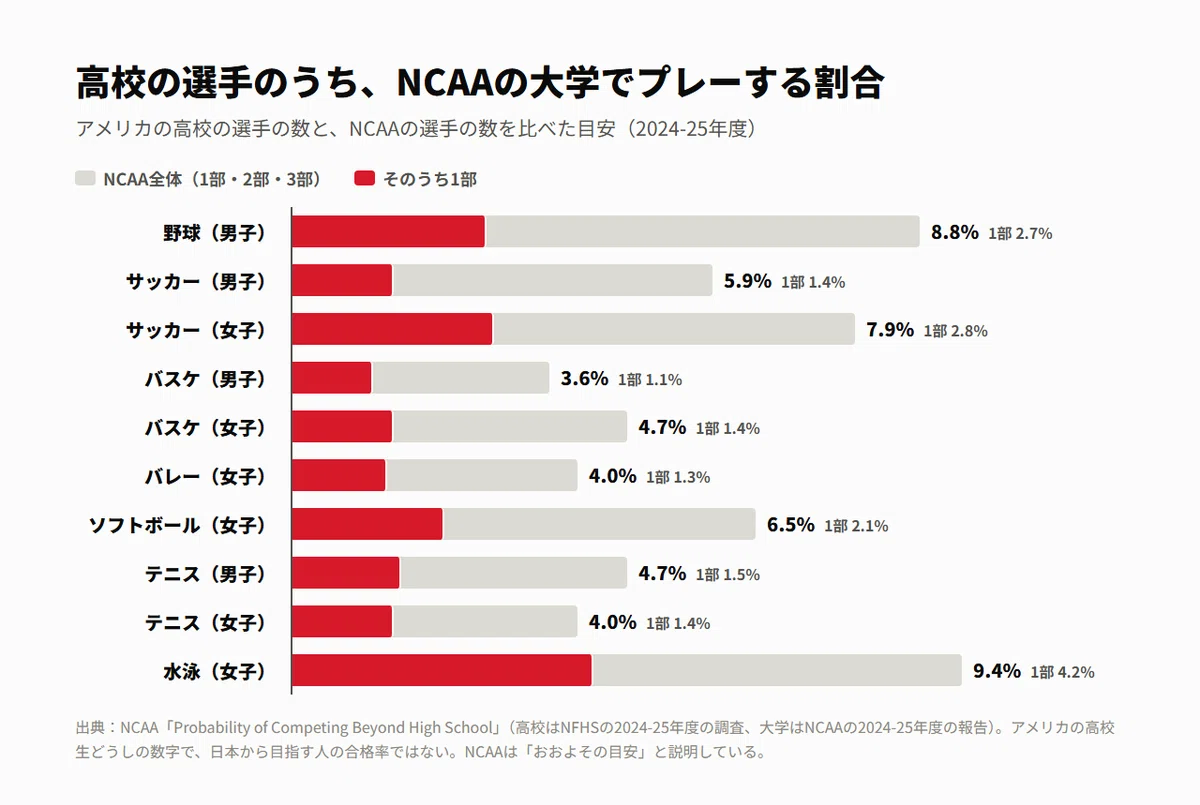
For example, in men’s basketball, only about 1 in 28 high school athletes plays for an NCAA university. If you limit it to Division I, it is about 1 in 90.
Three things to keep in mind when reading these numbers
These numbers are very helpful, but there are three things to keep in mind when reading them.
1. These figures are for US high school students
This percentage compares the number of US high school athletes to the number of NCAA athletes. It is not the acceptance rate for those aiming to go from Japan.
2. International students compete for the same spots
NCAA university teams include athletes from countries other than the United States. Those aiming to go from Japan will be competing for the same spots as not only US high school students but also athletes from all over the world.
3. The NCAA explains that these are “approximate guidelines”
The NCAA calculates this percentage by dividing the “number of NCAA athletes that year” by the “number of high school athletes that year.” They explain that because some people play multiple sports and some athletes do not compete in their first year, these are guidelines rather than exact numbers.
Don’t assume it has to be Division I
Looking at the charts, for any sport, the percentage of the entire NCAA is about two to four times that of Division I alone. In other words, if you expand your scope to include Division II and III, the entry point becomes much wider.
I believe it is better to keep options open—including Division II, Division III, and universities in organizations other than the NCAA—rather than deciding from the start that “it’s meaningless unless it’s Division I.” Being able to continue playing in college and graduating with a degree are also important goals.
Chapter 3: Scholarships Vary Greatly by “Division”
What you will learn in this chapter: How the structure of athletic scholarships differs between Division I, II, and III
“If you play sports at a US university, your tuition will be free thanks to scholarships.” Some people may have that image. But in reality, the scholarship structure is completely different depending on which division the university is in.
Division I: Scholarships can be awarded up to the maximum number of team members
Among Division I universities, those that participated in the 2025 “House Settlement” (a settlement of a major lawsuit regarding college sports, which will be explained in Chapter 4) have abolished the scholarship caps per sport starting in the 2025-26 academic year. Instead, a “maximum number of team members” has been set for each sport.
According to an explanation by the organization that manages financial rules for college athletes (CSC, College Sports Commission), universities can provide partial or full scholarships to all team members as long as they are within the maximum roster limit.
However, “can provide” does not mean “must provide to everyone.” The actual amount awarded varies by university and team.
Division II: Sharing a fixed “pool” among several people
Division II universities have a fixed “pool” of scholarships for each sport. According to the NCAA, examples are as follows (number of people converted to full scholarships):
-
Baseball: 9.0 people
-
Men’s Basketball: 10.0 people
-
Women’s Volleyball: 8.0 people
-
Track and Field/Cross Country: 12.6 people
Coaches distribute this pool among several athletes. Therefore, many athletes receive a “partial tuition” scholarship. The NCAA explains that athletic scholarships can be combined with academic merit-based scholarships and others.
Division III: No athletic scholarships. Yet, about 80% receive some form of aid
Division III universities cannot award scholarships based on athletic performance.
However, according to the NCAA, about 80% of Division III athletes receive some form of aid based on academic performance or family financial circumstances. Even without athletic scholarships, there is a possibility that tuition can be reduced through other scholarships.
Tuition Guidelines
When considering scholarships, it is also important to know the original cost of tuition. According to research by the College Board, an organization that conducts college admissions in the United States, the average tuition fees (the amounts published by universities) for the 2025-26 academic year are as follows.
-
Public 4-year universities (residents of that state): $11,950
-
Public 4-year universities (students from other states): $31,880
-
Private 4-year universities: $45,000
This is just for tuition; room and board costs are separate. Also, the amount for ‘residents of that state’ at public universities does not apply to international students who are not residents. Tuition for international students is determined by each university, so please check the information provided by each individual school.
I believe it is important for parents and children to calculate the numbers together—not assuming that ‘a sports scholarship will cover everything,’ but rather understanding ‘what percentage is covered by the scholarship and how the remainder will be handled.’
Chapter 4: New Rules Starting in 2025: From ‘Scholarship Caps’ to ‘Roster Limits’
What you will learn in this chapter: What has changed, the benefits, and what to be careful about
The catalyst was the ‘House Settlement’
In 2025, American college sports reached a major turning point. A lawsuit (the House case) in which college athletes sued the NCAA and others, arguing that ‘it is wrong for athletes not to receive money generated by their names and images,’ was resolved through a settlement.
With this settlement and the resulting changes to NCAA rules, two main things have changed:
-
At Division I participating schools, the scholarship cap per sport has been eliminated and replaced with a ‘roster size limit’ (this chapter)
-
Universities will be allowed to pay athletes directly (Chapter 5)
The ‘Before’ and ‘After’ for major sports
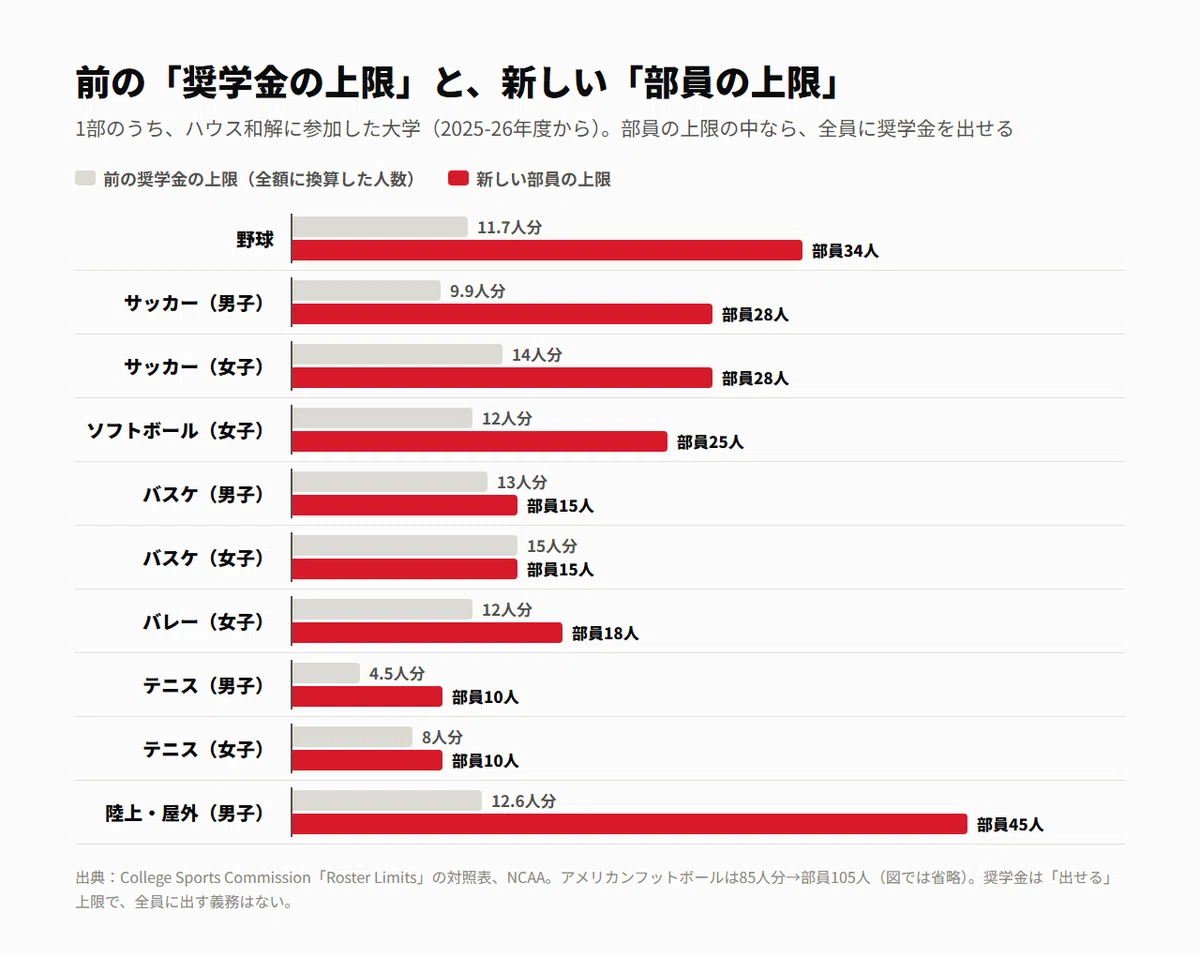
I have extracted major sports from the comparison table published by the CSC. On the left is the previous scholarship cap (number of full-equivalent scholarships), and on the right is the new roster limit.
-
Baseball: 11.7 scholarships → 34 roster spots
-
Soccer (Men’s): 9.9 scholarships → 28 roster spots
-
Soccer (Women’s): 14 scholarships → 28 roster spots
-
Softball: 12 scholarships → 25 roster spots
-
Basketball (Men’s): 13 scholarships → 15 roster spots
-
Basketball (Women’s): 15 scholarships → 15 roster spots
-
Volleyball (Women’s): 12 scholarships → 18 roster spots
-
Tennis (Men’s): 4.5 scholarships → 10 roster spots
-
Tennis (Women’s): 8 scholarships → 10 roster spots
-
Track and Field (Men’s, Outdoor): 12.6 scholarships → 45 roster spots
-
American Football: 85 scholarships → 105 roster spots
The Good News: The potential for more people to receive scholarships
For example, in men’s soccer, even in Division I, scholarships were previously capped at the equivalent of 9.9 full scholarships. If there were 28 players on the team, it meant many players received little to no scholarship money.
Under the new rules, it is theoretically possible to provide scholarships to all 28 team members. The CSC also explains that ‘opportunities to receive scholarships will increase even in sports that are not highly popular or revenue-generating.’
Points to Watch: Roster caps have been established
On the other hand, previously, even if a player didn’t receive a scholarship, there was a path to join the team as a ‘walk-on’ (a player who joins without a scholarship) in some sports.
Under the new rules, there is a cap on the total number of team members, regardless of whether they have a scholarship or not. If you don’t fit within the cap, you cannot be a team member. According to the CSC, players receiving scholarships or financial aid from the university must remain on the team roster for the entire academic year.
Why ‘verbal commitments’ to high school students are being rescinded
In the U.S., it is common for high school students to talk to college coaches and make a verbal promise (commit) to attend that university. However, a verbal promise is not a formal contract.
Recently, it has been pointed out that cases of these verbal commitments being rescinded are increasing in college baseball. A representative from a U.S. baseball scouting organization summarized the reasons on social media in October 2026 as follows:
-
Roster caps have been established, reducing the number of available spots
-
There are many players transferring from other universities, making it easier for coaches to choose experienced players
-
The new ‘5-year rule’ allows a single player to stay at a university for a longer period
Even if a coach genuinely evaluates a high school student, the number of team members, budget, or the situation regarding transfer players may change before that student enrolls. The explanation is that these factors are compounding.
This is an example from baseball, but roster caps exist in other sports as well. I believe that once you receive a verbal commitment, it is best to confirm early on ‘when and in what form it will become an official document.’
Chapter 5: The Era of Universities Paying Athletes: Approximately $1.8 Billion in the First Year. What About International Students?
What you will learn in this chapter: The first-year figures for money paid from universities to athletes, and what international students should be careful about.
In the first year, approximately $1.77 billion was paid to 34,915 athletes.
Another major change decided by the House settlement is that ‘universities can now pay athletes directly.’ In English, this is called ‘revenue sharing.’
The CSC announced the results for the first year (2025-26 academic year) on October 1, 2026.
-
Universities that paid athletes: 307 schools
-
Athletes who received money: 34,915
-
Money paid: Approximately $1.77 billion (across 45 sports)
Dividing this by the number of athletes, the average per person is approximately $50,700 (my calculation). However, this is just an average. Front Office Sports, a media outlet specializing in sports business, reported in June 2025, just before payments began, that ‘at many universities, about 75% of the distributed money is expected to go toward American football.’ It is safer to assume that there are significant differences depending on the sport and the university.
The cap per school is $21.58 million.
There is a cap on the amount of money a school can pay to athletes. In the first year, it was $20.5 million per school, and out of the 319 schools that participated in the settlement, 68 schools paid either the full cap or within 5% of the cap.
For the 2026-27 academic year, the cap has been raised to $21.58 million (announced by the CSC).
Money from universities and NIL contracts with companies are separate.
Another term that often appears in the news is ‘NIL.’ NIL stands for Name, Image, and Likeness, and it refers to athletes receiving money from companies and others for the use of their name or photo.
The CSC explains that payments from universities and NIL contracts with companies are separate things. NIL contracts are checked through the CSC’s review system (NIL Go).
Can international students receive it?
This is likely the point of greatest concern for parents and students aiming for this from Japan.
Many students studying abroad at US universities stay on an ‘F-1’ student visa. Under this visa, students are strictly limited in their ability to work and receive money.
Can international students receive money from universities as athletes? According to explanations from law firms, many universities treat this money as a ‘licensing fee for the use of a name or image’ and take the position that it is not compensation for work. However, it has been pointed out that if there are bonuses based on game performance, there is a risk it could be considered ‘compensation for work.’
As of October 2026, there does not appear to be any clear guidance from the US government.
This is a matter involving professional judgment regarding visas and the law. This article cannot definitively state what you ‘can’ or ‘cannot’ receive. When such issues actually arise, please be sure to check with your university’s international student office or an immigration law expert.
Student visa rules are also being affected by court cases
There is another development regarding student visas. The U.S. government announced a rule to set a maximum duration of ‘up to 4 years’ for stays on a student visa, which was scheduled to begin on September 15, 2026.
However, according to reports, a federal court in Massachusetts issued a ruling to postpone the start of this rule. As of October 2026, the previous system remains in place, but the legal battle is still ongoing.
Along with the ‘5-year rule’ for college sports (which I will explain in Chapter 6), you should also keep an eye on the future of visa rules.
Chapter 6: The First Step When Aiming from Japan: Procedures and Rules You Should Know
What you will learn in this chapter: Procedures at the NCAA office and things Japanese middle and high school students should know early on
There are 13,814 students from Japan studying in the United States
According to the ‘Open Doors’ survey compiled by the Institute of International Education (IIE) with support from the U.S. Department of State, there were 13,814 people from Japan studying at U.S. universities and other institutions in the 2024/25 academic year. Of those, 6,327 are studying at the undergraduate level (four-year universities or community colleges). Only a small fraction of these students are studying abroad for sports.
Registering with the NCAA ‘Eligibility Center’
International students who want to play for NCAA Division I or II universities must register with the NCAA’s ‘Eligibility Center’ to undergo an evaluation of both their academics and athletic performance. This is where it is confirmed whether the individual meets the requirements to compete in university games.
Required subjects and grades
According to the NCAA’s guide for international students, there are the following conditions regarding high school grades.
Division I
-
16 units of NCAA-approved subjects (core courses) (4 in English or native language, 3 in math, 2 in science, 1 in either English, math, or science, 2 in social studies, and 4 others)
-
A grade point average of 2.3 or higher in core courses (on a 4.0 scale)
Division II
Division III
As the term “native language” suggests, for Japanese students, Japanese language classes can also be counted within this category. Since which subjects are recognized as core subjects is determined by each country, please check the NCAA’s country-specific guidance.
Transcripts are required from the third year of junior high school. An English translation is also necessary.
According to NCAA guidance, for Divisions I and II, you need transcripts from the 9th grade (the third year of junior high school in Japan) onwards, as well as documents certifying graduation. For documents not in English, you must attach a certified, word-for-word English translation.
Also, if you are sending documents by email, they are not accepted from the student themselves; they must be sent by the school, a translation agency, or similar. It is safer to consult with your high school teacher early on.
Know the “19th Birthday” rule as well.
In June 2026, the NCAA updated the rules regarding the period during which Division I athletes can compete. For those entering university in the fall of 2027 or later, the system will be that “you can play for a maximum of five years if you enroll in university by the academic year following your 19th birthday.”
I imagine some people take a gap year after graduating from a Japanese high school to study English or prepare. In such cases, you should check early on whether this rule applies to you.
My case
After studying abroad at an American high school, I went on to a university in New York. While enrolled, I passed the tryout for the NCAA Division I soccer team and was on the team for a short period.
I did not have a scholarship. I was a “walk-on,” as introduced in Chapter 4, who joined the team by taking a tryout after entering the university.
On the other hand, that team had, to my recollection, about seven players from countries other than the United States, and they all received scholarships. Even within the same team, there were players who entered with scholarships and players who entered without them.
Replacing this with the current rules, everyone is counted within the roster limit, regardless of whether they have a scholarship or not. The path I took, joining the team through a tryout after enrollment, might be narrower than before if the roster spots are already filled. For those aiming for this in the future, I recommend contacting the coach early and checking the status of roster spots rather than thinking, “I can just try out after I enroll.”
When choosing a university, I also bought a directory of American university information myself and researched it to decide. Nowadays, a lot of information is available on the internet, but as we have seen in this article, rules change significantly in just a few years. I believe that the habit of checking “which year the information is from” is the most important thing of all.
Chapter 7: 6 Questions to Ask a College Coach
What you will learn in this chapter: Things to check when talking to a college coach under the new rules
As we have seen so far, the rules for American college sports have changed significantly in the last year or two. If you have the opportunity to talk to a college coach, checking the following six points will make it easier to understand “what your position will be” under the new rules.
1. Does this university participate in the House settlement?
Roster limits and rules regarding money from the university to athletes apply to Division I universities that participated in the settlement. The system is different for universities that did not participate, or for Division II and III universities. First, confirm which set of rules the university follows.
2. What is the roster limit, how many players are there now, and how many are scheduled to join next year?
There is a limit to the number of roster spots. If you know the maximum number, the current number of players, and the number of people graduating versus the number of people joining, it becomes easier to think about whether there is room for you.
3. Are scholarships available? What is the percentage, and what are the conditions?
Even if you are told that a scholarship is available, your family’s financial burden will change significantly depending on whether it covers full or partial tuition. Check the percentage, the conditions for maintaining it, and whether you can receive it in writing.
4. How are payments from the university to athletes and NIL deals handled for international students?
As seen in Chapter 5, the issue of international students and visas is not yet clear. It is reassuring to ask how the university views this and how they coordinate with the office for international students. For final decisions, please check with the university’s designated office or an expert.
5. When and in what form do verbal promises become official documents?
As seen in Chapter 4, verbal promises can be rescinded. Ask when they will become official documents and what happens if the situation changes before then.
6. How many international students are currently on the team?
In the US Congress, a bill has been introduced to set a cap on the percentage of international students on each team (as of October 2026, it has not been enacted). Knowing how many international students are currently on the team will give you an idea of the team’s atmosphere and their experience in accepting international students.
Tips for asking questions
There is no need to give the impression that you are suspicious with any of these questions. If you explain, ‘The rules have just changed, so as a parent and student, we want to understand them correctly,’ I believe most coaches will explain them carefully.
One more thing: in the US, a bill summarizing college sports rules (the Protect College Sports Act) passed the Senate on September 28, 2026. According to reports, it includes provisions such as allowing athletes to play immediately upon their first transfer to another university (waiting one year from the second time onwards) and codifying the five-year rule into law. However, it has not yet been deliberated in the House of Representatives, so it is unclear whether it will be enacted.
Rules may continue to change in the future. Once you hear an answer, verify it with official guidance from the NCAA or the university. I believe this habit is the best preparation.
Conclusion
What you can learn in this chapter: A summary of this article
Here is a summary of the key points of this article.
-
There are 1,074 NCAA member schools: 361 in Division I, 297 in Division II, and 416 in Division III (as of September 2026). There are 554,298 athletes (2024-25 academic year).
-
Among US high school athletes, about 3-9% play at NCAA universities in major sports. Limited to Division I, it is about 1-4% (2024-25 academic year).
-
Scholarships are available within the roster limits in Division I, shared among the roster in Division II, and there are no athletic scholarships in Division III.
-
Starting in 2025, the ‘scholarship cap’ at Division I participating schools changed to a ‘roster limit.’ While opportunities for scholarships are expanding, the number of roster spots itself is fixed.
-
Payments from universities to athletes totaled approximately $1.77 billion in the first year. Whether international students can receive them depends on visa issues; check with the university and experts.
-
If you are aiming for this from Japan, prepare your NCAA registration, core subjects and grades, and English-translated transcripts as early as possible.
Because the rules of American college sports are currently undergoing significant changes, it is important to think in terms of numbers while verifying ‘how current the information is.’ I hope this article serves as an initial map for parents and children to consider their future paths.
I would also like to introduce some previously written articles related to this topic.
Click here for an article introducing the atmosphere of American college sports games and the relationship between universities and their towns.
Click here for an article that aggregates the percentage of international student-athletes by sport and analyzes whether the proposed legislation on caps for international students is relevant to Japanese middle and high school students.
Click here for an article comparing three paths from Japanese high schools to aiming for the MLB, based on age, money, and degrees.
Moving forward, I will continue to share information based on data and official sources regarding American college sports and sports sponsorships. Thank you for reading until the end.
