


India has recently announced it’s bidding for the 2036 Summer Olympics. Under Prime Minister Narendra Modi, the country has embraced a form of Hindu nationalism that is repressive of Muslims.
With Turkey, Saudi Arabia and Qatar also weighing bids for the 2036 Summer Games, it’s an opportune time to ask: How are repressive regimes using international sporting events for nation-building purposes?
First and foremost, international sports events provide widespread media coverage and brand exposure. That media lens is attractive for authoritarian and repressive regimes, because having a western audience provides them with the opportunity to “sportswash” — to use the fanfare of the event to distract from unethical conduct in other areas.
Read more:
Sportswashing is just about everywhere – but it may be backfiring on the countries that do it
By hosting international sporting events, the intent is to improve the reputation of the host nation by using the immense popularity of sport to “wash” away poor publicity often associated with human rights violations.
Sportswashing can also work to establish broader global acceptance of repressive regimes when western institutions accept their wealth and acquiesce to their goals.
Saudi Arabia, Qatar
Saudi Arabia is an example. The country has heavily invested in boxing, golf and soccer in an apparent attempt to improve its global standing.
Its Public Investment Fund bought the Newcastle United soccer team in the English Premier League in a move widely viewed as sportswashing.
Read more:
More than money: The geopolitics behind Saudi Arabia’s sports strategy
Furthermore, Formula 1, a sport that’s increasingly popular in North America, holds showcase Grand Prix races in Bahrain, Azerbaijan and Saudi Arabia, exposing a captive western audience to these repressive regimes.
The Men’s World Cup in Qatar is a perfect microcosm of the power these events hold. Qatar compelled FIFA, and its sponsors, to bend to its will on several fronts.
First, Qatar was able to host the 2022 Men’s World Cup in November and December, at odds with FIFA’s usual summer schedule. This decision was made to avoid Qatar’s blistering summer heat.
Qatar was also able to enforce a late ban on alcohol sales at games and prevent teams and players from wearing rainbow armbands in support of LGBTQ+ fans. Both of these actions align with predominant religious beliefs in Qatar.
(AP Photo/Martin Meissner)
Displacing marginalized people
Beyond the Qatar Men’s World Cup, events like the Olympics have a long history of being heavily leveraged by host cities to protect and promote national prestige.
These events often compel host cities to displace marginalized citizens as they “clean up” in preparation for the influx of athletes, advertisers and foreign journalists.
The goal is to impress the world and put on a show for people visiting for the sporting event — even if what’s presented is misleading.
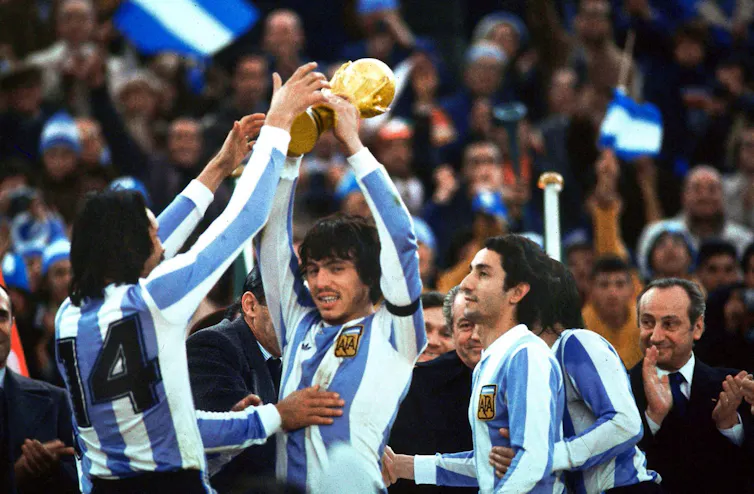
International sporting events have also been shown to contribute to oppression in authoritarian regimes. One example is Argentina and the 1978 World Cup, held during the country’s “dirty war” in which its ruling military dictatorship tortured, killed and disappeared thousands of political opponents.
Research conducted by European political science scholar Adam Scharpf and his colleagues has shown that before the tournament, repression turned increasingly covert, particularly during the working shifts of foreign journalists. After the tournament, the regime’s violence started up again in locations recently vacated by international media.
(AP Photo/Carlo Fumagalli)
Repressive regimes have also increasingly been making use of many different kinds of international sporting events.
Scharpf’s research found that the share of international sporting events hosted by autocracies fell from 36 per cent in 1945 to 1988 to 15 per cent from 1989 to 2012. Yet, since 2012, it has rebounded to 37 per cent.
That trend is likely to continue with the bids made for the 2036 Olympics.
Nation-building
So why are international sporting events popular again with repressive regimes?
First, sport presents an opportunity to achieve nation-building goals. This goal is at the heart of the study of politics and sport.
Sport possesses a powerful symbolism that can be exploited to great affect in forming a coherent national identity. Sport is generally seen as a symbol of national prestige that aligns with nationalist aspirations.
Additionally, sport has also shown itself to be an ideological safe space for repressive regimes.
Historically, the intersection of sports and political causes has been more accepting of conservative causes. In fact, there has often been hostility towards the introduction of newer progressive causes into sporting events, whether it’s through athletes, teams and leagues.
Read more:
How professional sports leagues that embrace social justice causes could influence politics
Conservative causes
In North America, for example, men’s professional sports teams have historically engaged with certain political causes popular among conservatives, namely the military and law enforcement, while neglecting other causes, such as the plight of marginalized members of local communities.
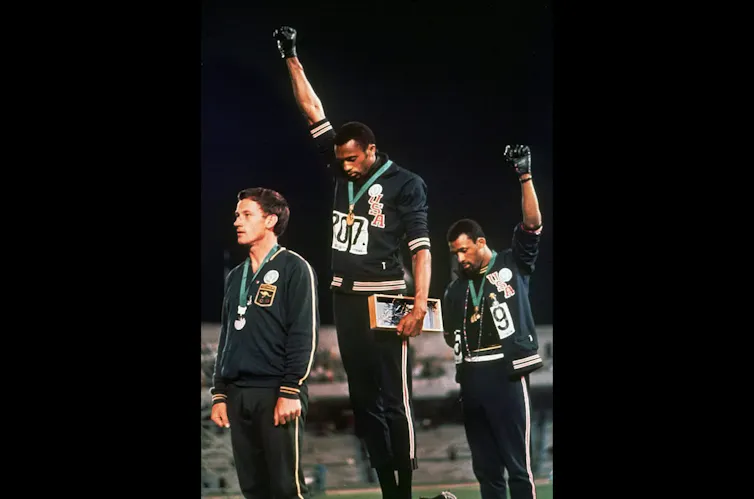
Furthermore, athlete or fan activism that may run counter to the goals of these repressive regimes is likely to face strong resistance. The protests undertaken by American sprinters John Carlos and Tommie Smith during the 1968 Olympics are an illuminating example of how athlete activism often receives a strong backlash.
These protests were met with resistance and disapproval, with many in the public believing their demands for racial equality were unnecessary and inappropriate.
This view has largely persisted, and underpins continually held beliefs that sport is an improper venue for political messaging.
(AP Photo)
Media coverage often dehumanizes activist athletes and portrays their causes as dangerous to society, which tends to increase hostility towards the athlete. What’s more, when athletes protest in support of social causes, they often see their job market and marketing profile take a hit. Colin Kaepernick, the ex-NFL quarterback, is a prime example of this.
Read more:
Nick Bosa’s MAGA hat vs. Colin Kaepernick’s kneeling: Will the NFL reveal a double standard?
Symbiotic relationship
But why are international sporting organizations increasingly turning to repressive host nations?
First, these regimes are likely to acquiesce to international sport organizations. Olympic committees and FIFA often require hosts build single-use sport facilities for their events. Repressive regimes are less likely to face the kind of democratic backlash that often arises when using public funds for spectacles that carry little public benefit.
Secondly, these regimes have been willing to bribe officials to gain the votes necessary to win their bids to host these sporting events.
That means repressive regimes provide members of international sporting organizations with benefits as well. In effect, there is often a symbiotic relationship between these countries’ regimes and international sporting organizations.
Hosting international sporting events brings immense prestige and profit to both the organizations and repressive regimes, but any gains come at an unethical cost — sacrificing human rights and justice for power and profit.
