



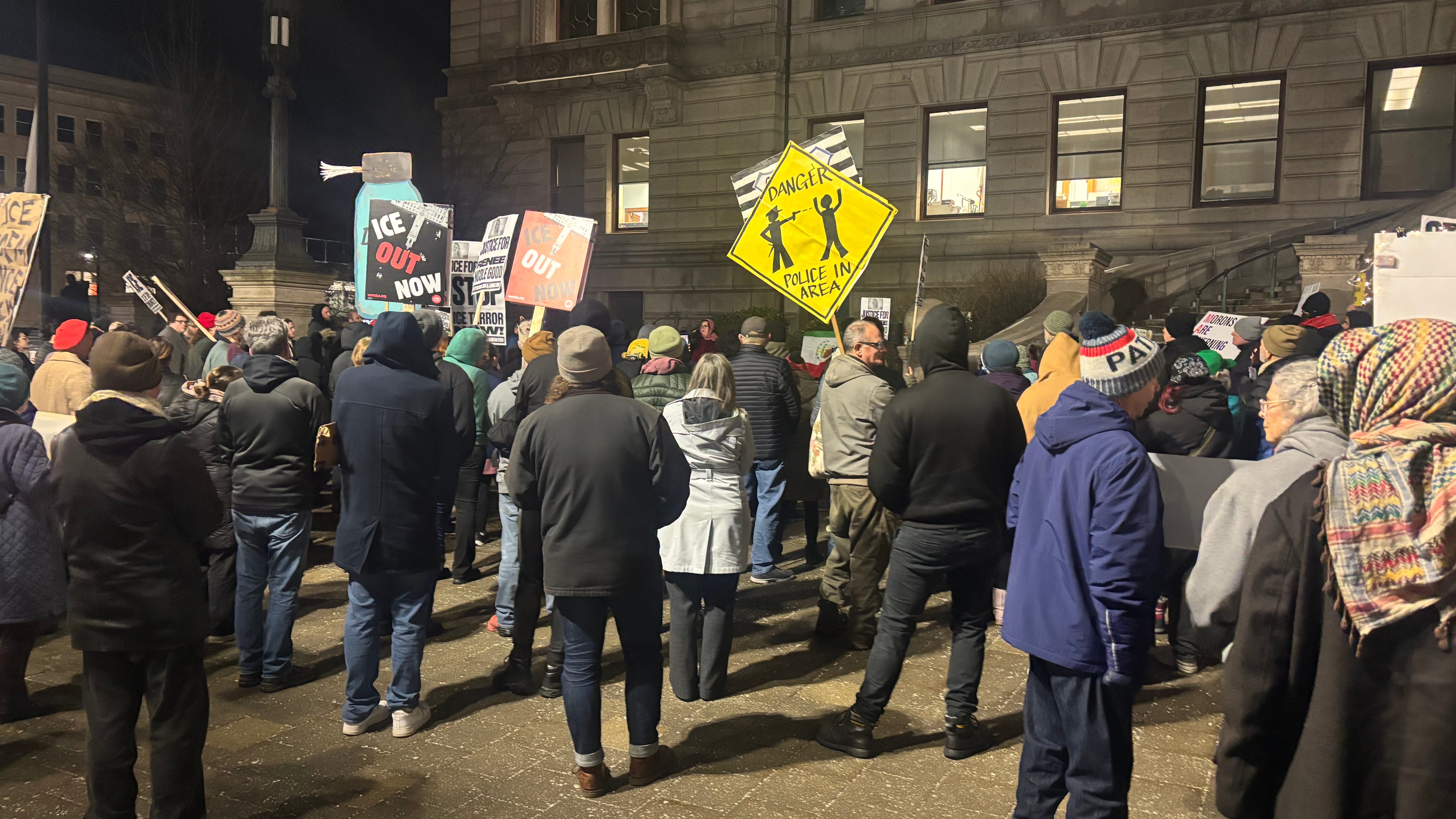


Protest at City Hall
Laura Gagnon of Worcester Party for Socialism and Liberation leads chants at protest following killing of Renee Nicole Good
- In all-party primaries, sometimes known as top-two primaries, all candidates are on one ballot, regardless of political affiliation.
- Voters can vote for any candidate on the ballot, and the two candidates who receive the most votes advance to the general election.
- If the proposal passes, Massachusetts would become the fourth state to use this type of primary.
A proposal to convert Massachusetts’s state primary elections to “all-party primaries” is inching closer to appearing on the November ballot.
Massachusetts currently has semiclosed primaries, in which Democrats can vote in Democratic primaries, Republicans can vote in Republican primaries and unaffiliated voters can vote in the primary of their choice in statewide elections. But a new proposal would eliminate this system and instead make state primaries nonpartisan.
The question still has a few hurdles to clear before it appears before voters this fall. But in case it does, here’s what to know in order to make your vote.
What are all-party primaries?
In all-party primaries, sometimes known as top-two primaries, all candidates are on one ballot, regardless of political affiliation. Voters can vote for any candidate on the ballot, and the two candidates who receive the most votes advance to the general election.
If the proposal passes, Massachusetts would become the fourth state to use this type of primary for statewide elections. California and Washington have a top-two primary, while the top four vote getters move on to the general in Alaska.
Advocates for this format argue that it gives moderate candidates a better chance advancing to the general election ballot, according to the National Conference of State Legislatures. However, opponents say that because the format makes it possible for two candidates of the same party to advance to the general election, it reduces voter choice.
Boston already uses an all-party primary system it calls a preliminary election. In the 2024 Boston mayoral primary, the two candidates who made the general election were both Democrats.
Will all-party primaries become law in Massachusetts?
The proposal still has a few steps to go before it could become law.
After receiving over 79,000 signatures and being certified by the Massachusetts Secretary of the Commonwealth’s Office, the question now heads to the Legislature, where it has until May 5 to act on the proposal.
If the Legislature chooses not to pass the proposal, the petitioners will need to gather 12,429 more signatures to place the question on the November ballot for voters to decide on.

