


Local News
A new zoning proposal would limit projects in a key redevelopment district, reflecting rising concern over the industry’s footprint statewide.
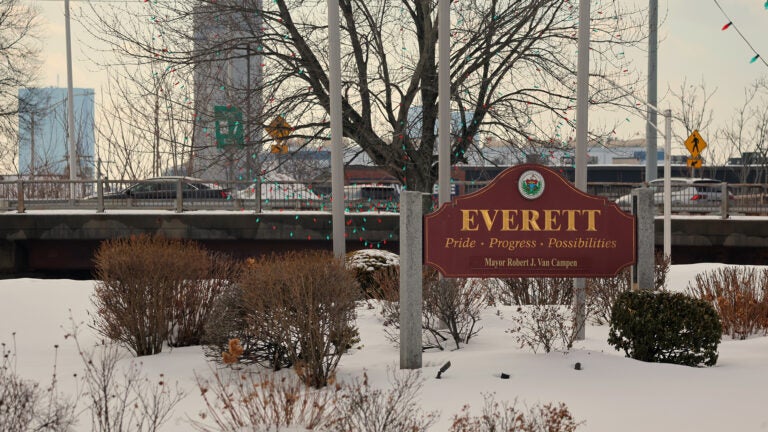
As backlash against data center development grows in Massachusetts, Everett is moving to get ahead of it.
The Planning Board voted unanimously April 6 to endorse an ordinance that would restrict data centers in Everett’s Docklands Innovation District (EDID), a 100-acre redevelopment site near the Mystic River. The proposal now heads to the City Council, which must approve it twice before it can take effect.
The move positions Everett among the first municipalities in the state to proactively regulate a rapidly expanding industry, and one of increasing concern.
A shift from by-right to tightly controlled
Section 37 of Everett’s current zoning code was enacted in 2024 to establish the Everett Docklands Innovation District (“EDID”), a district aimed at encouraging economic development at a formerly industrial area of the city.
Under Section 37, data centers are allowed by right to be built in the EDID. The proposed zoning ordinance would amend this section of the zoning code by setting parameters around data center development. And data center proposals would need a discretionary special permit and facilities would be capped at either 20,000 square feet or five megawatts of capacity, whichever is smaller.
Any data center would also have to be an ancillary use within a different, larger development.
“We didn’t want to see a standalone data center, because that kills any type of activation of the site,” Everett Planning Director Matt Lattanzi said. He pointed to the data center atop Macy’s in Boston’s Downtown Crossing as a prime example of what an “attractive” data center could look like, if one was ever proposed in Everett.
Projects would also be subject to Planning Board review for criteria pertaining to noise, water, electricity, and job creation.
The ordinance is tied specifically to the EDID, a 100-acre site that developer The Davis Companies has proposed turning into a mixed-use development with industrial, high-tech manufacturing, lab/office, retail, maker, and/or residential space.
Local concern, national trend
Everett’s action comes as communities across the state and country grow wary of the rapid expansion of data centers, which power cloud computing and artificial intelligence but require enormous amounts of electricity and water.
Massachusetts currently has 45 data centers, according to DataCenterMap, with the majority located in the Boston area. Though, resistance is growing.
In Lowell, city councilors recently approved what is believed to be the state’s first temporary moratorium on new data center development. Gov. Maura Healey has said she won’t support a ban on data centers, and instead, said the state needs more of them.
Nationally, more than 140 activist groups across 24 states are campaigning against new data centers, citing concerns about noise, air pollution, and strain on local resources.
A Harvard public health analysis of a Virginia facility found data centers could generate up to $99 million annually in health-related costs, even when operating within state regulations.
Those concerns are front of mind in Everett, which Planning Board member Stephanie McColaugh said has “been the dumping ground for Greater Boston’s industry for a long time and not really gotten any benefit from that.”
From potential ban to targeted limits
Initial regulatory discussions in Everett focused on banning data centers outright, reflecting strong public opposition. But the ordinance was later amended to restrict and regulate data centers in the EDID, according to McColaugh.
The ordinance has drawn significant public backing, including a petition with more than 1,200 signatures.
The Davis Companies, the developer of the site, has not proposed a data center, both McColaugh and Lattanzi made clear. But they do have a master plan special permit in front of the planning board that could allow a wide range of uses (such as a data center) permitted under current zoning.
McColaugh said Everett is trying to act proactively — before a data center project is formally proposed — rather than reacting after the fact.
“I think a lot of communities have seen these data centers spring up in their backyard, and there’s really no recourse at that point,” McColaugh said. “So we’re being proactive.”
Environmental justice at the center
Officials cast the ordinance as an environmental justice measure — portions of Everett are designated as an environmental justice community — with large low-income populations already burdened by a concentration of industrial uses.
“We oftentimes have historically gotten the uses that no one wants but everyone needs,” Lattanzi said. “But we are trying to reshape that future and control our destiny a little bit more.”
For many in Everett, a city known for its industrial legacy, the debate isn’t whether to develop the Docklands, but what kind of development should take root there.
“I’m pro development in the city, but I think it’s clear that this is not the development that Everett is looking for,” McColaugh said.
What comes next
The Planning Board’s endorsement of the ordinance now heads to City Council to be voted on twice, and a separate citywide version of the measure is also in the works.
If adopted, Everett’s approach could serve as a model for other municipalities navigating similar pressures.
“It’s the Wild West,” McColaugh said, calling for clearer statewide standards. “It’s incredibly inefficient to have to do this on a city by city scale.”
Lattanzi too hopes Everett’s effort becomes the sparkplug for statewide action.
“We might be one of the first movers in Massachusetts, but I would be shocked if we were the last.”
As demand for digital infrastructure continues to surge, the outcome in Everett may offer an early signal for far Massachusetts communities are willing to go to shape — or resist — the physical footprint of the digital economy.

Sign up for the Today newsletter
Get everything you need to know to start your day, delivered right to your inbox every morning.
